
Photo courtesy of Stacey Nedrow-Wigmore
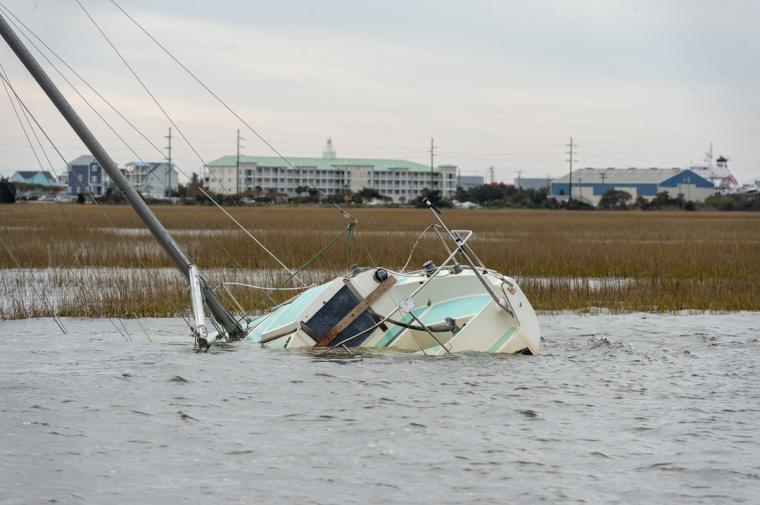
Here’s an indicator of how serious the problem of abandoned and derelict vessels (known as ADVs in the fishing world, and which continue to impact water sports events) has become: It’s getting its own conference.
The 2026 BoatUS Foundation’s Turning the Tide Summit is scheduled for December 6-9, 2026 and is actively seeking speakers to discuss the problem.
SDM first reported on the problem in 2024; at the time, BoatUS was offering grants to events and communities who wanted to address their problems and to remove ADVs from their waterways.
Information on recipients of the program can be found at this link. Grants were awarded to organizations and destinations in Alaska, Guam, Louisiana, Maine, North Carolina, Oregon, the Virgin Islands and Washington State.
Gene Gilliland, Bassmaster’s Conservation Director, who is also a member of the Sportfishing & Boating Partnership Council, told SDM in 2024 he was all too aware of the problem of ADVs and how they affect not just the waterways but those who use them.
“We have been discussing the issue of abandoned and derelict vessels for several years,” he notes. “As you might expect, with the emphasis placed on coastal waters, most bass anglers would have a hard time connecting the dots on how this might affect them.”
“However,” he continued, “there are a number of tidal bass fisheries that are quite important both to tournament and recreational anglers. We hold events on the Sabine River in Orange, Texas; Winyah Bay in Georgetown, South Carolina; James River in Richmond, Virginia; and the Upper Chesapeake Bay in Northeast, Maryland. Coastal Louisiana (Venice to Lake Charles), although not as much of a tournament destination, is still a vibrant fishery.”
The problems, Gilliland added, have been exacerbated by weather events.
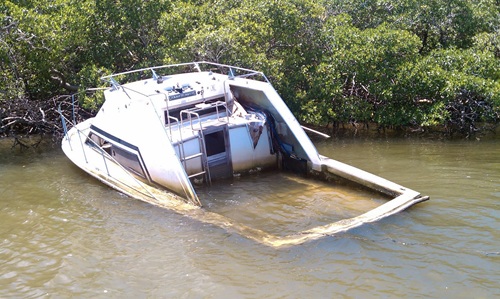
“Each of those locations has had issues with hurricane and storm surge/flooding damage that have created navigation/safety hazards for other anglers and boaters.”
Compounding the problem is the fact that ADVs are expensive and time-consuming to remove, and that responsibility for them, in the past, has not been the jurisdiction of any one organization, such as a city, ports organization, parks department, fish and game entity, etc.
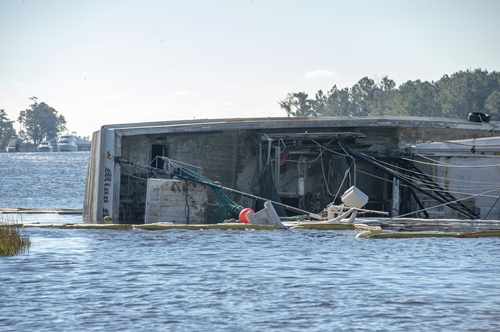
According to BoatUS, “ADVs litter ports, waterways and estuaries all over the country and can cause major problems. These boats can crush or smother sensitive plants and corals, sink or move during coastal storms, threaten safe navigation and contribute to economic losses. Removing ADVs is a costly effort, often averaging more than $24,000 to remove a single boat. For many communities, there may be no local funding for removal of vessels, and navigating complicated funding programs can be challenging for communities with limited time or resources.”
$24,000 is an amount many organizations can’t begin to cover, even though the removal of even one boat can make a tremendous difference in the quality of a waterway and the experience of those passing through it.
Additionally, not much attention is paid to the problem of small ADVs, although there certainly are estimates of losses of larger vessels, which tend to be more high-profile.
Which brings us right back to the meeting that BoatUS has planned. That summit is expected to bring together government agencies, environmentalists, marine professionals and recycle and waste management experts nationwide to explore best practices for responsible and sustainable removal and disposal of ADVs and boating-related debris, along with sharing emerging technologies and innovative recycling programs.
The BoatUS Foundation is seeking speakers who can share their experience and expertise regarding:
- Projects pertaining to ADV removals and vessel turn-in programs.
- Projects and efforts that focused on sustainable disposal and recycling solutions for ADVs and boating-related debris.
- Initiatives and/or programs geared towards preventing ADVs and boating-related debris.
Interested speakers are invited to apply here.
The meeting is open to all those who are interested in the topic. Attendees will have access to resources, panel discussions and keynote addresses that focus on ADVs and sustainable disposal solutions for boating related waste, including fiberglass and shrink-wrap.
This summit is part of the BoatUS Foundation ADV Program, whose ultimate aim is removing ADVs from the nation’s coastal waters and the Great Lakes.
The program also includes the creation of a national database to pinpoint locations of ADVs and track their removal; event owners and anglers, as well as others, can provide information on ADVs that might not be listed at this time. These efforts are supported by the National Oceanic and Atmospheric Administration (NOAA) Marine Debris Program.
About the Author