


Photo © Juan Alejandro Bernal | Dreamstime.com
Just when you thought it was safe to go back into the water FIFA website.
The 2025 FIFA Club World Cup, widely considered to be a dress rehearsal for the big tournament in 2026, saw record high temperatures, leading Gianni Infantino, FIFA’s president, to declare that the following year, covered stadiums would be used to host many of the day matches.
But, notes Forbes. “only around 30 percent of the 104 scheduled matches for the World Cup, 31 games, are set to take place in stadiums with roofs. The selection of host cities and venues was finalized in 2022, and with the tournament now just a year away, organizers, venues, cities and local authorities are deep into planning, implementation and operational rollout.”
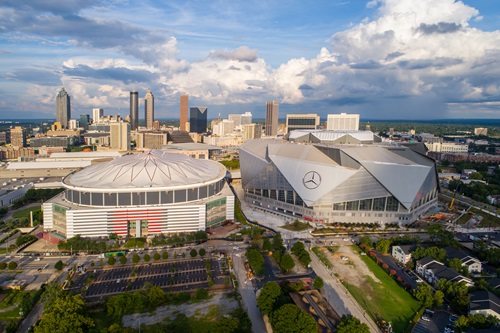
According to Yahoo! Sports, there are five covered stadiums on the schedule next summer. They are BC Place in Vancouver, SoFi Stadium in Southern California, AT&T Stadium near Dallas, NRG Stadium in Houston and Mercedes-Benz Stadium in Atlanta. Four of those are have retractable roofs; however, they are football stadiums, designed to hold heat in rather than let it out. Additionally, the grass must be irrigated to stay healthy, which creates humidity in the facility. The only solution will be to run the air conditioner constantly, which, with any luck, will work.
A total of 16 stadiums across the USA, Canada and Mexico will host play. There are 10 group-stage days with three or more games slated for open-air stadiums. And five of eight games from the quarterfinals onward (games that Europe will expect to be aired in prime time) will be outdoors.
But Infantino says games will be played indoors.
Do the math and you can see that yeah, that’s a problem.
It wasn’t just the heat, though, Yahoo! added; it was the weather itself: Six Club World Cup matches — though only one in a 2026 World Cup host city — were suspended for at least 30 minutes by severe weather, leading to complaints from coaches and players.
But thunderstorms are indeed far more common in the U.S. than in Europe and other regions. They delay Major League Soccer and Major League Baseball games (as well as innumerable youth tournaments) every summer. They were one reason FIFA considered putting the 2026 World Cup final at the indoor AT&T Stadium in Texas rather than outdoors in North Jersey, according to some sources.
“What you’re seeing right now is very typical. This is not unusual at all,” Ben Schott, the National Weather Service’s operations chief, told The Athletic after multiple Club World Cup delays. “Next year, we may be going through the same thing.”
But it’s unlikely that even with the threat of heat and electrical storms, Infantino will be able to back up his words of moving matches around, meaning he probably won’t have to face down a mob bearing pitchforks and torches. With less than a year to go until kickoff, it is unrealistic to even think about making arrangements for alternate venues. Ditto the idea of requiring any stadium to build a roof in time for next year.
There are other covered stadiums in the U.S., of course, but most are not built to FIFA standards, in which fields are longer and wider than NFL football fields. Many lack the necessary seating and infrastructure, and they already have contracts in place for other events. There is also the fact that most closed stadium have synthetic turf surfaces, which FIFA will not use for its play. And hotels in those areas may already be busy with other bookings.
So what option does that leave? While it is theoretically possible to increase the number of matches played in roofed stadiums, it is not a realistic choice, given the logistics involved and the financial and operational consequences for host cities, for stadiums and yes, for FIFA itself.
Additionally, because there is a limited number of venues that have roofs, more concentrated play would cause excessive wear of the playing surfaces – even before organizers take into considerations the issues with ticketing, hotel reservations, fan transportation, television schedules and other aspects of an international tournament.
Forbes notes that a climate-safe solution must be found:

“A climate-smart Men’s World Cup should include free water refill points, venues powered by renewable energy, shaded seating areas, real-time WBGT monitoring to trigger more frequent cooling breaks and extended half-time intervals during heat spikes. Additional measures like misting stations and climate-controlled concourses and transit hubs could support player and fan comfort and safety but can come at an environmental cost.”
All things considered, Infantino probably spoke too soon – and knows that he did and wishes he hadn’t. At a press conference, though, he was less than clear on his plans, noting only, “Of course the heat is an issue but we will see what we can do.”
And at the end of the day, it was an issue that could have been taken into consideration previously. An article in ESPN stated the obvious: “By hosting a World Cup in the summer in the U.S., FIFA has already agreed to be hostage to the weather, with both hot/humid conditions and thunderstorms capable of delaying games. But with wildly different conditions in different stadiums and venues, it needs to do everything it can to make the tournament as fair as possible.”
And that fairness needs to extend to the hosting cities.
SDM will continue to follow this issue as it develops.
About the Author