


Photo © Glen Edwards | Dreamstime.com
Pickleball is an absolute juggernaut in the tournament space, as well as at the facility level.
In fact, a recent survey by the Sports & Fitness Industry Association and DUPR showed that one of the biggest complaints among players was court congestion.
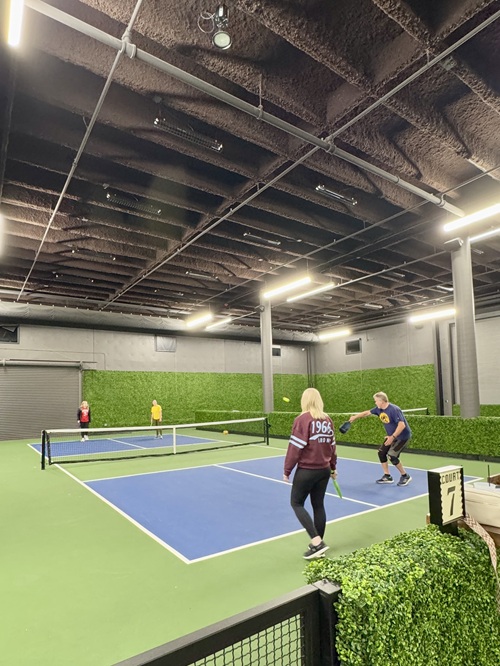
Rushing to fill the space have been not just park and rec departments and private clubs who are adding pickleball courts, but a variety of franchise organizations with a similar business model: Set up clubs in big-box stores, warehouses and other retail spaces that are no longer operational.
Dubbed “picklemalls,” the business concept has proliferated; Forbes identified 12 such franchise and club organizations — but acknowledged there were many others.
Some organizations, rather than have franchisees use a vacant space that is on the market, recommend builds that go from the ground up, so as to avoid problems with pre-existing sites.
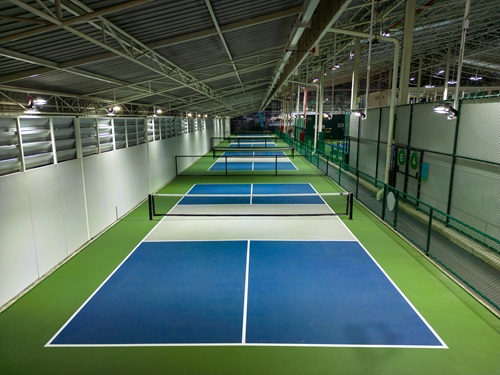
Much growth in the franchise venue space is driven by companies that market such venues as a slam-dunk investment with guaranteed ROI, as well as a high-profile place to host tournaments and championships.
Unfortunately, however, the cracks are starting to show in the picklemall venue marketplace and the complaints are getting louder. As it turns out, if you build it, the players (and the tournaments) won’t necessarily come.
According to Franchise Inspector, it’s not about the sport. It’s about the business model.
“Pickleball as a sport is thriving,” the article notes. “Pickleball franchises as investments remain largely unproven.”
The article notes that in their rush to capitalize on the booming sport, many investors are hitting the market blind:
“Pickleball franchises combine high upfront investment with a very short operating history. Buyers are committing significant capital, long term leases, and personal guarantees in a category that has not yet produced a large number of proven, mature operators. That imbalance between risk and track record is what deserves closer scrutiny.”
The investment range, notes the article, is significant, as is the amount of space a pickleball club consumes. Additionally, because most individuals lack the disposable wealth to simply drop into the concept without concern about risk, a loan is usually involved; alternatively, individuals will liquidate retirement accounts. Sometimes, they'll do both.
That’s its own problem, adds Franchise Inspector, since “if the business underperforms, there’s no clean exit.”
The issue has come to the attention of USA Pickleball, the governing body, which, according to Carl Schmits, Chief Technical Officer, receives dozens of calls from prospective venue owners.
The organization has partnered with Ground Rule, which specializes in sports facility development and management, and as a result, has been able to create a suggested framework of questions that need to be answered and a process that should be followed prior to breaking ground.
“Right now, we are in a period that is a lot like the Wild West,” notes Schmits, “which came along with the gold rush. The rules were loose and a lot of decisions were being driven by passion and greed, which led to a number of failures. There were, however, some people whose enterprises were very successful but they were the ones whose decision making was driven by not just passion but integrity and planning.”
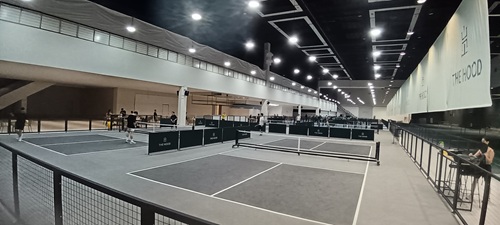
Tournament facilities, he adds, require a large number of courts, necessitating a commensurate investment.
Competitive venues also require enhanced spectator seating, robust Wi-Fi systems, a P.A. system, streaming capabilities, more rest rooms, more parking, vendor space, electrical hookups and other amenities, according to the publication, Pickleball Courts: Construction & Maintenance Manual, which USA Pickleball co-publishes with the American Sports Builders Association.
Many facility business failures, Schmits notes, come down to owners who do not understand the risk of investments as well as a number of other exacerbating factors:
Lack of Due Diligence: Often, would-be club managers, in the rush to sign onto what they see as a sure thing, don’t research the market carefully — if at all.
“You need to do a deep dive on your market,” Schmits says. “That includes a feasibility study: the potential economic impact, research into the demographics and research into your competition, meaning how many other facilities are out there. You have to know the market potential and you have to have a business plan.”
In many cases, competition will not take the form of other clubs, Schmits says; it will include places players can access free of charge, such as those at the park and rec level.
Lack of Site Investigation: A vacant big-box store that initially looks perfect for redevelopment may have electrical and plumbing issues, a leaking roof, mold and flooring problems (as well as other setbacks), all of which will need to be addressed before the facility is ready for use.
The cost of those improvements will be borne by the individual or corporation who holds the lease or who is the owner of the property; in many cases, this work will need to be carried out before any conversion work on the facility can begin.
For outdoor facilities, notes Schmits, acoustic studies are key to deciding whether a site can support a pickleball facility at any level, including one with multiple courts. USA Pickleball has heard multiple stories about facilities that failed because of complaints aobut noise.
Lack of Construction Knowledge: Owners need to know (and often do not know) that payment will need to be rendered to all contractors (those working on the building itself, as well as those who are putting in the pickleball surface, nets, lighting and divider fencing and other amenities), according to the agreed-upon schedules.
Problems have already been noted by sports facility contractors who have to stop work because bills go unpaid, which tends to happen when owners get behind on payments, having expected a faster startup and more immediate ROI.
“I recently was hired by a franchisee of a large national pickleball brand to build out their facility,” noted a court contractor who spoke on the condition of anonymity. “I was the second court builder that was brought on as the first wasn't paying their subcontractors and when they were asked about it, walked off the job. This contractor had been suggested by and supported by the national franchise and now nobody was doing anything to protect or help the franchisee.”
Meanwhile, the contractor notes, the owner has a half-completed club, is being sued for non-payment by the last construction crew and the bank is holding up any further payments to the new subcontractors who had taken over.
“The club owner is going to lose their entire fortune fighting this and the franchise has been silent the entire time - meanwhile promoting this contractor at other locations."
Lack of Club Management Experience: Enthusiasm for, and even love of, pickleball is great — but, as they say, it doesn’t pay the bills. It also doesn’t create a knowledgeable club owner.
Successful club management demands specific expertise, not just in a specific sport but of all aspects of club operations: member recruitment (and retention), employee acquisition, management and retention, insurance and bonding, payroll management, budgeting and financial management, as well as multiple other areas of competency.
“Passion alone won’t make a facility successful,” adds Schmits.
The Club Management Association of American (CMAA) offers a certification program for club managers; three levels of certification are offered. Colleges like Ferris State offer a Tennis Management degree that trains students in all aspects of the industry.
Lessons from the Running Marketplace
Unfortunately, it is not the first time the sports event space has had people rush into what looks like a guaranteed money-maker, only to come up short.
Both theme runs and obstacle course races (known as OCR) were wildly popular 10 to 15 years ago. In fact, every week brought announcements of new brands of obstacle runs as well as novelty and themed fun runs (the kind where runners wore costumes, were sprayed with color and got into tomato fights at the finish line, as well as other hooks).
Both types of races cost more than the average 5K and temporarily, the industry virtually exploded with them. Because of their offbeat appeal, they caught the attention of many non-runners who participated as a social experience with friends and bragged about them on social media.
At the same time, many events were being put on by individuals and organizations with no prior race experience, something runners noticed and complained about when they realized events were poorly organized. In some cases, registration fees were collected but races were never held, leaving registrants to sort out the problem of refunds through credit card companies.
Running USA reported that the industry peaked in 2013 when 19 million runners crossed the finish line at U.S. running events over all distances after having been steadily rising from only 5 million participants in 1990. Since then, however, the market has self-corrected and traditional races again rule the roost.
Many theme and obstacle runs have gone by the wayside and recently, Savage Race, a high-profile obstacle event owner, cancelled all but three of its races for 2026. This came on the heels of its “by the numbers” report, which showed an overall decline in 2019 and in years following.
Worth noting: Savage Race is offering those who signed up for cancelled races three options: a full refund, a transfer to one of the three existing races — or registration in either a Spartan or Tough Mudder race, two of the OCR properties left in the market.
About the Author