

Photo © ibreakstock | Dreamstime.com
Sudden cardiac arrest (SCA) — often linked to structural or electrical abnormalities in the heart — is the leading cause of death in young athletes. Those abnormalities can go undetected until it’s too late, which is why the purchase and installation of automated external defibrillators (AEDs) by youth sports organizations, high schools and other groups surged after Buffalo Bills safety Damar Hamlin suffered (and survived) SCA on national TV during a Monday Night Football game in early 2023.
According to the American Heart Association, an estimated 23,000 children under the age of 18 experience cardiac arrest outside of a hospital each year in the United States. Of those, about 40% are sports-related.
In recent weeks, new laws passed in at least three states take sharp aim at increasing heart safety for high school student-athletes.
On July 1, Florida became the first state in the country to mandate heart screening of all high school student-athletes before they can compete. The Second Chance Act requires them to undergo an electrocardiogram, or EKG, at least once during their high school playing career. The quick test checks the heartbeat, records the heart’s electrical signals and can help diagnose irregular heartbeats known as arrhythmias, according to mayoclinic.org.
According to Central Florida Public Media, “the Florida High School Athletic Association has until the 2028-29 school year to develop bylaws or policies that prohibit a student-athlete who gets an abnormal EKG result from participating in tryouts, practice or competition.”

“Almost every screen I’ve had — even if I have five kids or 150, there’s almost always one,” heart screening director Melissa Hartman told FirstCoastNews.com at a free screening event hosted in Julington Creek by the nonprofit SCA-awareness group Who We Play For. “It’s something people don’t think about because you don’t feel it. You don’t usually have any symptoms. All of a sudden it just happens.”
Meanwhile, in Vermont (where the survival rate from SCA is among the lowest in the country), Gov. Phil Scott in late June signed a comprehensive bill that includes a requirement for cardiac emergency response plans in all schools and school athletic programs. Whether in the classroom or on the playing field, having a plan in place to enable faculty, staff and students to quickly and correctly respond to a cardiac emergency can save lives, American Heart Association officials say, adding that in schools with AEDs, approximately 70% of children survive cardiac arrest; that’s seven times the overall survival rate for children.
“These plans should not be optional, suggested or recommended,” said Kyle Peckham, head athletic trainer and assistant athletic director at Rice Memorial High School in Burlington, Vt., as well as a key advocate of the implementation of cardiac emergency response plans across the state. “While the incidence in young athletes may be rare, the consequences of not being prepared are devastating. These plans will make the difference between life or death in students, faculty, staff and visitors of Vermont schools.”
WCAX.com reports that while approximately 215 schools in Vermont have AEDs, only 84 have cardiac emergency response plans. The American Heart Association says having a plan can increase cardiac arrest survival rates by 50 percent.
The bill, which was part of a larger act pertaining to “miscellaneous amendments to education law,” requires all Vermont schools and athletic programs to implement cardiac emergency response plans beginning with the 2026-27 school year. These plans will include the establishment of a designated response team, regular CPR and AED training, strategic placement and maintenance of publicly accessible AEDs, practice drills, coordination with emergency medical services and ongoing evaluation to ensure effectiveness.
The American Heart Association and its HeartPowered grassroots network of advocates — made this policy a top priority to ensure increased survival rates from cardiac arrests. As a founding member of the Smart Heart Sports Coalition with the NFL in 2023, the American Heart Association has built strong coalitions in all states.
Indeed, shortly after Vermont’s new law hit the books, Indiana Gov. Mike Braun signed “Jake’s Law,” which is named after a 17-year-old football player who died of SCA on a high school football field in La Porte in 2013.
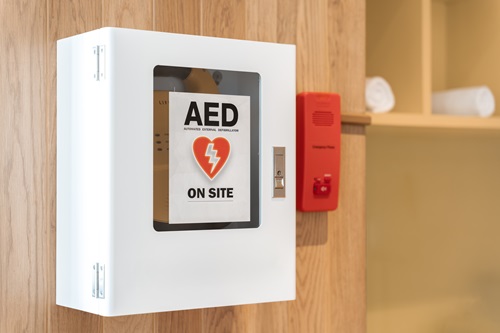
“The new law mandates that an AED be present at every venue where students face an increased risk of sudden cardiac arrest,” according to WIBC.com. “Furthermore, schools must develop specific action plans tailored to each venue to effectively respond to cardiac emergencies.”
“AEDs and immediate CPR dramatically increase the chance of survival for someone experiencing a sudden cardiac arrest,” said Christina Cesnik, Indiana government relations director for the American Heart Association.
In Hannibal, Missouri, meanwhile, Hannibal Public Schools also made news when all sports facilities were equipped with weather-safe AED units. And while it's not quite as proactive as screening for heart issues, it does, say officials, provide a way to respond immediately, should an emergency occur.
“These AEDs ensure that if a cardiac emergency happens during a game or while someone is using the track after hours, help is immediately within reach,” said HPS Athletic Director Clint Graham. “We’re grateful to [Marion County Ambulance District] for helping us make our facilities safer for everyone.”
About the Author