

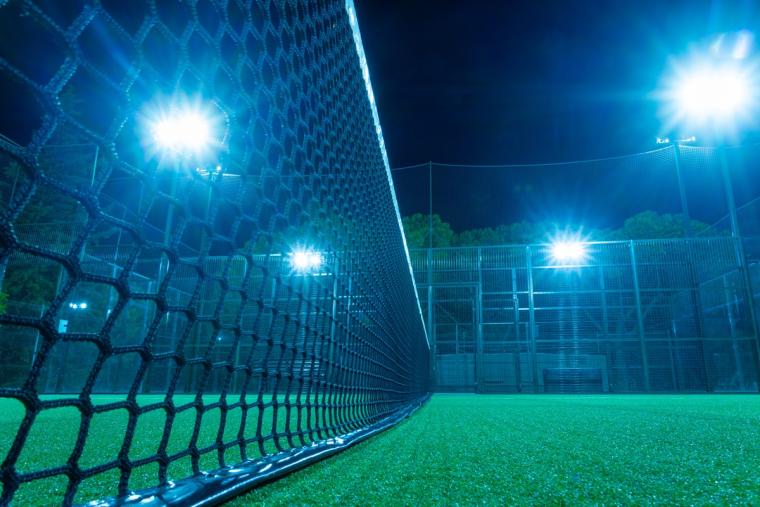
Photo © Mikedesign | Dreamstime.com
Much has already been written about the growth of padel, being heralded as the next big court sport. And accordingly, it’s gaining favor as clubs and residences add venues.
In fact, according to a report by the International Padel Federation, the number of sports facilities with padel courts worldwide has increased by 24.1 percent. Florida has emerged as the fastest-growing U.S. market for padel with the largest number of padel courts in the country (41 percent of the total number of courts in all states).
Other states with large concentrations of padel courts are Texas with 18 percent of all courts in the U.S, California (10 percent) and New York (4.7 percent).
One of the most popular settings for the sport is in clubs and facilities that offer other court sports as well. (In fact, the USTA National Campus in Florida, while generally considered an epicenter of tennis in the Southeast with 100 dedicated courts, also features major facilities for pickleball and padel, and hosts training, leagues and tournaments for those sports.)
But the sport has a darker side, and owners need to pay attention. Two men were killed and a third sustained catastrophic injuries while unloading a padel court for assembly.
Courts arrive in kit form; owners are responsible for providing the labor to unload and assemble the court and a stable base to which the court can be secured, as well as any power hookups, should the kit contain lighting.
The incident took place while the men were unloading the kit from a truck. The two who were killed were hit, then pinned under, the glass panels of the court. A third worker sustained an injury so severe that one of his arms had to be amputated.
The tragedy highlighted a problem that plagues the sports industry: The use of untrained labor to install sports facilities on the part of owners who want to cut corners. Sports are often a victim of their own success, and in the rush to add facilities, crucial aspects of the job may be overlooked.
Usually, the practice of using unskilled labor results only in a poorly constructed facility, such as a field that does not drain properly, a tennis or pickleball court built to incorrect dimensions or a beach volleyball court that does not hold up to regular play.
And in general, say sports-specific contractors, the problem is exacerbated by the fact that instructions (which may or may not be correct) can be found on the internet where they are often summarized by AI.
Unfortunately, the worst-case scenario is what recently happened with the padel court. And what has followed has been a flurry of finger-pointing, with the driver of the truck saying he was unaware of what was taking place, and the owner of the club (where the court was to be located) claiming not only that the accident took place outside the boundaries of the club, but that the men involved were not club employees (they were, in fact, local college students).
However, the use of unskilled labor (which does save money) in this case came at a terrible cost. The glass panels used in a court, according to the publication, Padel Courts: Installation and Maintenance Manual, can exceed a weight of 400 pounds each (a court kit generally contains more than a dozen panels of glass).
The book notes, “Specialized expertise and heavy equipment are needed to lift and place the panels of glass without danger to workers or damage to the glass.”
“This is why you want to be using trained professionals who are bonded, and who have insurance,” stated Northeast Padel’s Eric Loftus, who headed up the editorial committee for the manual. “What happened to those men could have been avoided.”
But it is not the only bad press the sport's facilities have gotten recently. Other courts have been constructed incorrectly, leading to player injuries, as well as to a need for total reconstruction.
The glass used in the courts also is being viewed as an ecological hazard following multiple bird strikes against the panels, prompting at least one city to require the installation of decals on the glass that can be seen by birds (but that do not interfere with spectator viewing).
“We had a client in Maine, and we put in a court for them in October,” says Loftus. “Unfortunately, that’s migration season and they called to tell us birds were dropping like flies. They bought some decals and that took care of the problem.”
A variety of decals can be purchased inexpensively online, including on Amazon. (One court kit company, apparently seeing the opportunity, has begun offering bird-safe glass panels. The downside: Specialty glass costs more, so it is offered only as an option.)
But padel’s woes continue. Courts (in fact, sports facilities of all types) that are lighted for night play have also been called out as a hazard to local wildlife. Additionally, complaints have been made about the noise generated by padel, which some describe as similar to gunshots.
Another problem (not limited to padel facilities but certainly noticeable there) is that in the rush to install courts, many are overlooking the permitting process, including one incident that recently unfolded in Palm Beach.
About the Author