
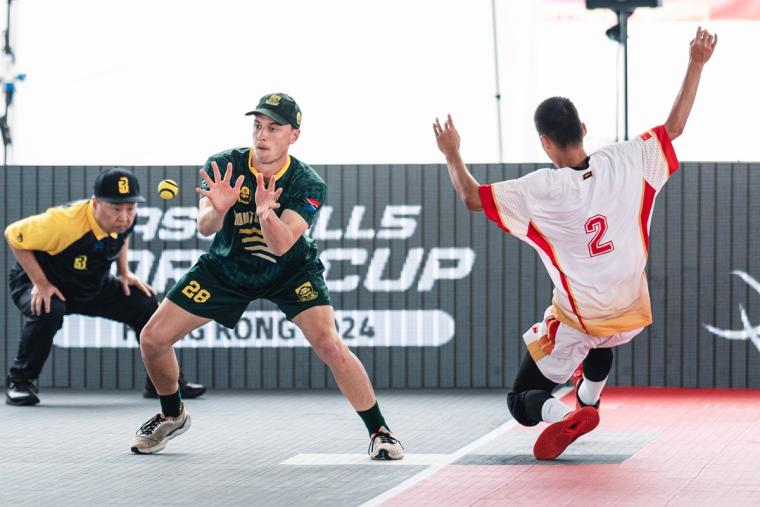
Images courtesy of the World Baseball Softball Confederation (WBSC)
Baseball5, the urban version of the sport that uses no bats and no gloves and is played on a hard surface, might have its roots in the Great American Pastime but its international growth is leaving these shores behind.
The World Baseball Softball Confederation (WBSC) launched the Baseball5 project in 2017. The game, requiring only five players and a rubber ball to play, was based on the 'four corners' game that was born on the streets of Cuba.
According to Forelle, “In many communities, players couldn't afford the expensive gloves and protective equipment required for traditional baseball. As a result, an alternative form of the game developed, focused on creativity and improvisation.”
Born out of those games, Baseball5 uses a soft rubber ball and is played on streets or really any surface (no special complexes with springy baseball turf or red clay infields needed). In some cases, bases are marked in chalk or created using any items as a placeholder. While there are competition surfaces that can be rolled out, the game was intentionally designed to be set up anywhere, from school playgrounds to parking lots to open fields, thus eliminating the need to rent facilities.
It’s a mixed gender 5v5 game where a hitter bounces the ball, then strikes it with his or her hand before heading for first base while the fielding team tries to get him or her out (the same as in regular baseball). Each game is five innings long.
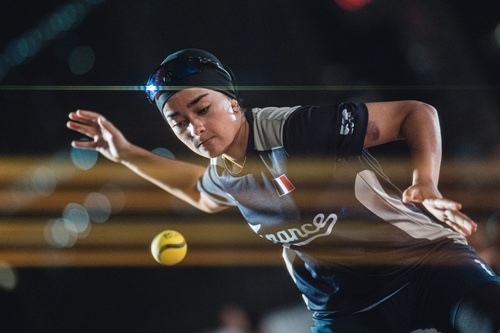
Youth Olympic Games Debut: Now, less than a decade later, Baseball5 is set to make its debut in the 2026 Youth Olympic Games, which will be held beginning in late October in Dakar. The Baseball5 World Cup, meanwhile, will come to Puerto Rico in December.
Puerto Rico is establishing itself as a power in Baseball5, having recently hosted the Baseball5 School National Championship.
And that’s about as close to the USA as you’re going to see high-level Baseball5 action; the sport here largely is being promoted at the grassroots level by USA Baseball, which highlights it as an option for gym classes, as well as club and rec play on campuses.
The hashtag, #playeverywhere, is being co-branded with Baseball5, which USA Baseball terms “the hip, new partner of America’s Pastime, a lightning-fast, high-energy game that shares the same core principles as traditional baseball. But here’s what makes it special: it can be played anywhere, with just a rubber ball. No fancy equipment needed.”
USA Baseball states that organizers have “stripped away all the complicated stuff and created a dynamic, mixed-gender team sport that’s all about instant fun.”
Additionally, the NGB notes, it’s a time-efficient sport: “Each team has five players – plus reserves – and depending on the format, a game can last between 15 and 20 minutes. Baseball5 is the epitome of a cool sport: it’s sustainable, inclusive, youth-focused and makes non structured spaces come alive with athletic energy.”
More information about Baseball5 can be found on USA Basebal’s side at this link. The rules, including a diagram of the playing area, can be downloaded free of charge here.
The arrival of Baseball5 as a Youth Olympic Games podium sport is a tremendous coup for WBSC. One of the complaints about having traditional baseball and softball in the Olympics has long been the fact that it has been dominated by only two or three nations, since both baseball and softball lack popularity in many other areas.
In fact, this exclusivity on the medal stand was a prime reason that baseball and softball were originally removed from the Games.
They have since been allowed back, but only as showcase sports (meaning the host of each Olympics has to suggest its inclusion).
Baseball and softball, for example, were included in the Games placed in Tokyo, not in the Games in Paris and will be next seen in 2028 in Los Angeles. Whether they will appear in 2032 in Brisbane is anyone’s guess; lobbying efforts have already begun.
Will Baseball5 take its place in the Olympics? It could happen; after all, the IOC tends to look fondly on youth-focused and mixed gender sports, particularly those with smaller teams.
An additional advantage is that upon development, Baseball5 was introduced to all nations at the same time, eliminating the ‘deep bench’ baseball and softball enjoy in the USA and thereby creating a more level playing field worldwide.
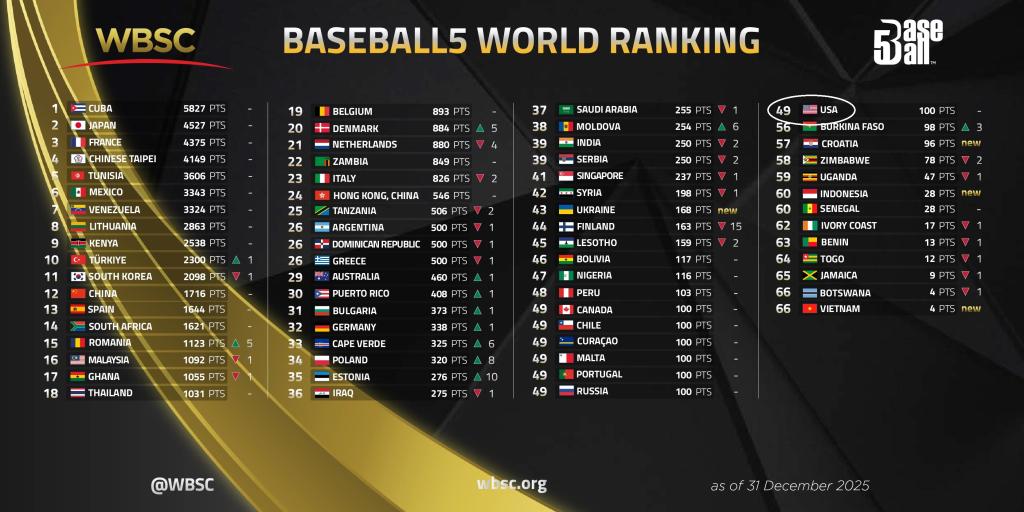
Case in point: In terms of the 66 nations competing in Baseball5, the USA is close to the bottom, tied for 49th place with six other nations. (In case you're wondering, Cuba holds the top spot in both the adult and youth rankings.)
About the Author