

Photo © Yuri Nadezhin | Dreamstime.com
The Winter Olympics had some unexpected excitement and for once, it was unrelated to judging or politics. This, in fact, had to do with history.
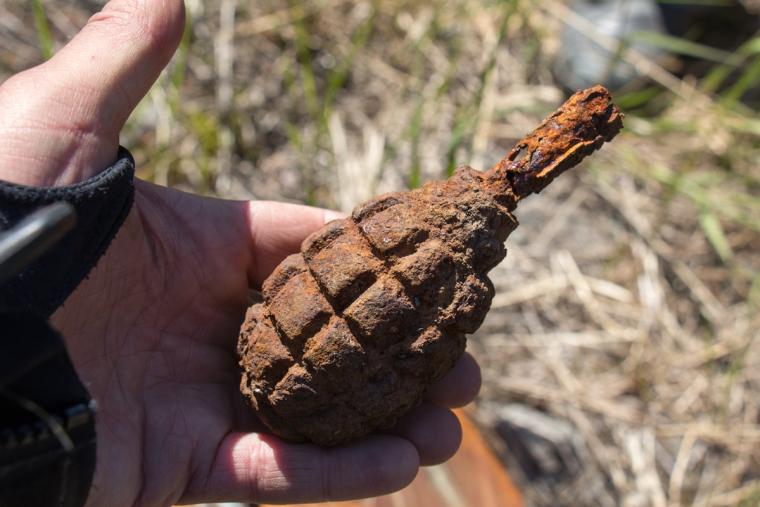
Last Sunday, a grenade that dated back to World War II was found in the woods near the ski-jumping venue. According to Italian news sources, the heavily rusted grenade was lying on the banks of the River Avisio, partially covered by snow, near a bridge above a parking lot.
Local authorities arrived on the scene and defused the device; in fact, most of those at the Games were unaware of what was happening.
The article noted, “There was only minimal disruption to traffic during the operation. The SS48 state road in the Dolomites only had to be closed for a few minutes to carry out the work.”
That’s weird but what’s weirder is that it’s not the first antique ordnance that has caused consternation when it was found near in or near a recreation area or sports venue. In Germany, an 1,100-pound American bomb was discovered during construction not far from the home of Bundesliga soccer club Mainz 05. Some rescheduling of events took place but the bomb was defused without incident.
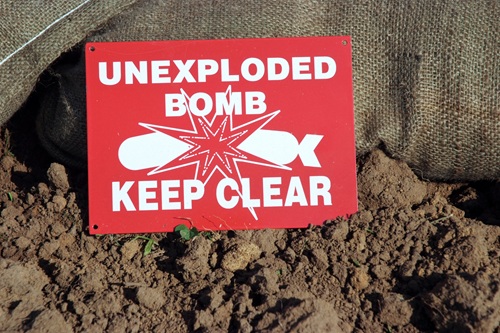
And in fact, in some areas of Europe (where unexploded Allied bombs still are being discovered decades after the conflict), the need to search for such artifacts is so commonplace that companies often hire private bomb disposal teams to check that sites are safe before construction moves forward.
Tools used to find unexploded ordnance (known in the trade as UXO) include magnetometers, ground-penetrating radar (GPR) and electromagnetic induction systems, which identify buried metal or anomalies. Drones (UAVs) equipped with sensors enable rapid, large-area scanning, while handheld magnetic locators are used for precision detection by EOD technicians. Those who work in the field of location and disposal of materials have extensive training.
The USA has had its fair share of incidents where UXO remediation became necessary. In Waco, Texas, a construction crew unearthed two bombs while working on a new Little League field. Authorities determined the devices were not live but likely practice bombs from a former military installation that was on the same site during the first World War.
In Rhode Island, a live World War I-era explosive found at Fort Adams State Park in Rhode Island had to be detonated. (The bomb had been dug up by workers who, not knowing that it was still dangerous, carried it into the park office and left it on a desk. A maintenance worker, understanding the danger, contacted police, who alerted a bomb squad.)
Construction workers in Houston found a WWI artillery shell in a park and reported the find to authorities, who safely detonated it. The area was once a training base and, fittingly, the section undergoing renovation had been earmarked as a memorial park honoring fallen soldiers.
Hawai’i has been particularly troubled by the UXO problem, according to this news report, which notes that cleanup efforts have dragged on and in many cases, have stalled out. Ordnance, including thousands of grenades, mortars and bombs, are still suspected to be present.
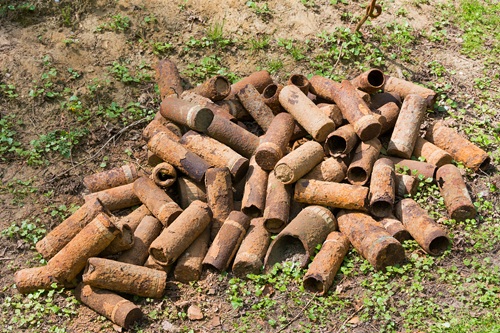
Over the years, munitions have been discovered in neighborhoods, hidden on pastureland and even in the garden at Waimea Middle School.
In the last 20 years, the Army Corps of Engineers has recovered more than 2,700 unexploded ordnances in the Waikoloa Maneuver Area, which spans between 160 and 190 square miles and includes the popular resort area in Waikoloa.
The sheer size of the area, the article noted, makes identification and recovery a challenge.
In Baltimore, just prior to Thanksgiving, construction workers at Fort McHenry National Monument and Historic Shrine unearthed a cannonball, prompting closure and evacuation of the area, as well as the closure of gas lines, while experts were called in. The cannonball, which was determined to date back to the 19th century, was removed to a safe area.
Much of the concern stemmed from the fact that the fort is located in a heavily populated urban area, and just five minutes from the South Baltimore Little League fields.
About the Author