

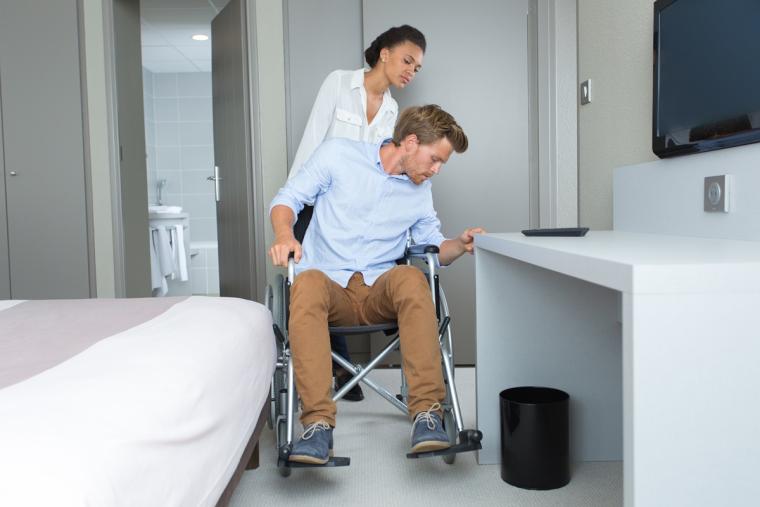
Photo © Auremar | Dreamstime.com
Last year, the Americans with Disabilities Act celebrated its 35th anniversary. But amid all the celebrations, there needs to be a reckoning: How far has the U.S. come, really, in accommodating individuals with disabilities?
We know there are a tremendous number of sports programs, and that more destinations are hosting them, which has led to a spike in travel by those with disabilities.
But one aspect that has not changed as much as it should, say travelers who have specific mobility or other needs, is that of hotel facilities. And that seems counterintuitive.
“Twenty-five percent of all adults in this country, or one in four, have a disability,” states Shuan Butcher, communications manager at Move United, an organization of community adaptive sports programs. “So a property that goes above and beyond in accessibility can definitely have an edge in the market.”
National Public Radio recently studied the issue. And for its research, it interviewed 50 individuals who use wheelchairs, scooters, walkers and other mobility devices.
The findings did not engender confidence. No traveler had ever had a seamless experience every time he or she traveled, and most reported at least one hotel problem each time. A sampling of the problems:
- The usefulness of online or call-in reservation systems, in terms of securing an accessible room, is uneven at best. Some travelers have reported reserving accessible hotel rooms, then arriving at hotels to discover those rooms were no longer available.
One problem, NPR noted, is that people without disabilities occasionally ask for the accessible rooms, believing they will be bigger; they generally are not but a truly accessible room contains less furniture to create better maneuverability for wheelchairs and might look larger to the untrained eye.
- In many cases, rooms designated as accessible had design flaws, such as misplaced toilets and grab bars in bathrooms, or showers with thresholds and doors that blocked wheelchairs.
Separately, Butcher notes that showers with benches often have the bench at one end and the controls to turn on the water at the other, creating problems for seated individuals. Additionally, hotels are switching to shower, conditioner and body wash dispensers are often located at too great a height to be reached by an individual who is unable to stand.
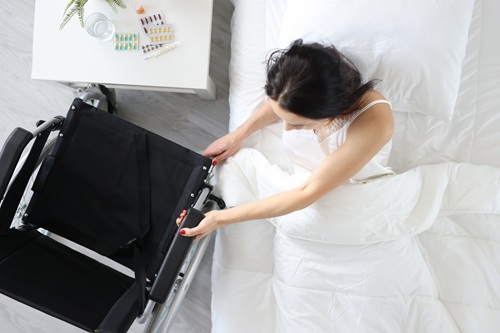
- Often, in rooms that were supposedly accessible, beds are too high off the floor to reach from a wheelchair, forcing some users to sleep in their wheelchairs and others to injure themselves falling when trying to get into or out of the bed. Note: Many hotels are raising the heights of their beds in order to create a sense of luxury, and accessible rooms often get the same treatment.
Additionally, many rooms are cluttered with furniture, making it hard for those with mobility issues to move about safely, and doors are not as easily operated when a user needs to get in or out.
There are plenty of problems in common areas as well. Butcher, for example, has noticed that breakfast buffet areas can be problematic, particularly if their layout makes it impossible for a person in a wheelchair to see what is on the buffet, open chafing dishes or serve themselves.
ADA Southeast quoted an article in the Washington Post that discussed the issue. Jeremy Warriner told reporters that part of the reason problems in the industry persist is that people don’t understand the importance of the ADA or what it is meant to provide. He also said businesses may not realize they are violating the law.

Warriner worked in the hospitality industry for more than 10 years and had managed hotels throughout his career. He stated that in both his formal education and his workplace trainings, he said he learned very little about the ADA and how to implement it.
It wasn’t until he became a double-leg amputee after a car accident that he understood the importance of having accommodations. After his accident, he realized the only automatic, accessible door he could go through to get into the hotel where he worked didn’t function. When he questioned staff, he was told it hadn’t been working for years.
The problem, say Warriner and others with disabilities, is that change must be complaint driven. Even then, because travelers with disabilities represent a minority, the complaint may not be looked at as a priority and repairs, changes or upgrades may be very slow in coming, and perhaps may not arrive in time for the next traveler with a disability.
Advocates for those with disabilities say that ADA establishes a baseline for accessibility; however, to be truly welcoming, buildings should go beyond its requirements.
“Obviously as a public facility, all hotels meet ADA standards,” says Butcher. “But meeting it to the letter of the law is not enough. Meeting the bare minimum would typically never suffice when it comes to other standards. Hotels, sports venues and all public facilities should adhere to the Seven Universal Design Principles, which help make the built environment easier and safer for everyone at all ages and all stages of life.”
An article in MS Focus, the magazine published by the Multiple Sclerosis Foundation, made it clear that the community of those with disabilities is fighting back:
“The law is enforced by individual lawsuits brought by disabled persons against hotels,” noted the author of the article. “I am disabled and committed to enforcing the ADA. These are my responsibilities: I check into a hotel that is believed to be in violation of the ADA. I take pictures of the violations and get a bill proving that I stayed there. I make a reservation to return to the hotel. I send all the documents to my attorney and expert to file a lawsuit against the hotel.”
The author further notes that in almost all of the cases, the hotel entered a settlement agreement or consent decree to correct most of their violations and agreed to pay reasonable attorneys and expert fees. (He also has an expert and lawyer conduct an inspection of the hotel after the date negotiated for the completion of corrections to confirm compliance with our agreement.)
Related Content
About the Author