

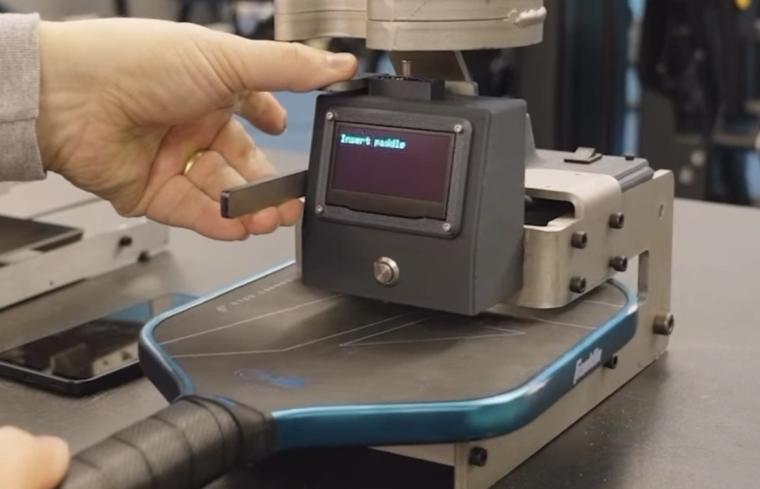
Photo courtesy of Pickleball Instruments
Imitation might be the sincerest form of flattery but in the sports equipment market, there’s another word for it: Counterfeiting. And nowhere is it more evident right now than in pickleball, where cheaply made paddles that look like high-end versions are being sold on the black market and causing trouble in the industry.
The Dink, an online pickleball resource, notes, “CRBN spent nearly two years perfecting TruFoam, the sport’s first mainstream foam-core pickleball paddle—a bona fide technical breakthrough that helped set the stage for many brands to follow suit. Almost immediately, the fakes came pouring in.”
The counterfeit versions that claimed to be TruFoam were being sold on platforms like Alibaba, Temu and Facebook, some for as little as $17.
Adds The Dink, “None of them were real. Not even close.”
Pickleball has continued to rise in popularity. According to Sports & Fitness Industry Association (SFIA) 2025 Topline Participation Report, there are now 19.8 million participants in the U.S., marking a 45.8% increase from 2023 and a staggering 311% growth over the past three years.
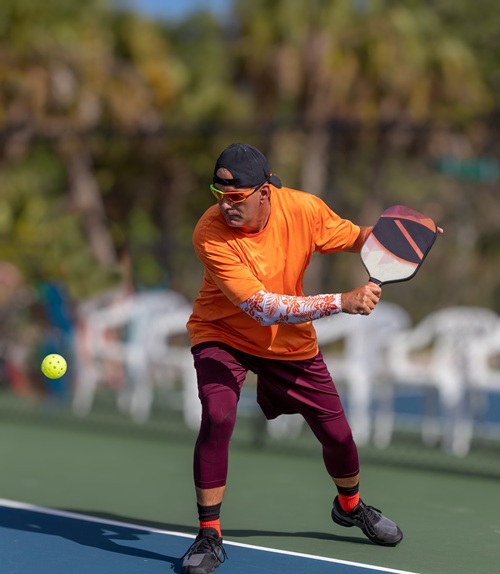
Those players want paddles. And many gravitate toward high-end products, including TruFoam (at slightly less than $300 per paddle) as well as others that edge toward (and go beyond) the $400 mark.
That, in turn, has led players to scour the web, searching for deals, including those offering prices too good to be true.
The pickleball industry is fighting back to protect and educate players, preserve competitive integrity, and safeguard the future of the game.
Participating in the initiative under the banner of the United Pickleball Association are the Association of Pickleball Players (APP Tour), Dynamic Universal Pickleball Ratings (DUPR), Major League Pickleball (MLP), Professional Pickleball Association (PPA Tour), United Pickleball Association of America (UPA-A), USA Pickleball (USAP) and the World Pickleball Federation (WPF).
"This issue has aligned every organization," noted a joint statement released earlier this month. "There is no room for counterfeit paddles in the sport."
In mid-January, USA Pickleball and Pickleball Instruments launched a new event-based initiative: Field testing of paddles. The move allows for onsite testing of paddles using Pickleball Instruments’ equipment to evaluate coefficient of friction, deflection and weight/balance properties.
The concept is simple, says Riley Burgess, Vice President of Equipment Compliance: Bring the testing to the game.
USA Pickleball tested paddles at its events in Glendale, Arizona and Las Vegas, Nevada, both of which were Golden Ticket events, making attendance (and wins) highly sought after and thus, creating large attendance.
Players were intrigued by the concept of testing, Burgess added and in fact, were ready to hand over their equipment.
"I was preparing to have the difficult conversations but what we have found is that people were very curious; they liked the idea."
Out of nearly 1,000 paddles tested, he added, a few counterfeits were identified.
Testing takes less than five minutes per paddle, he added. Each tested paddle receives an RFID sticker that allows players to scan and view their equipment data. An accompanying mobile app will enable players to track how individual paddles change over time and will provide added confidence that all competitors are using compliant equipment.
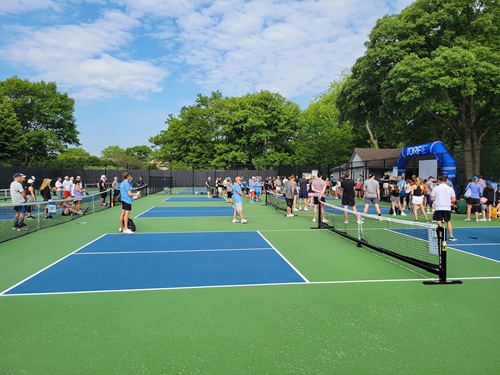
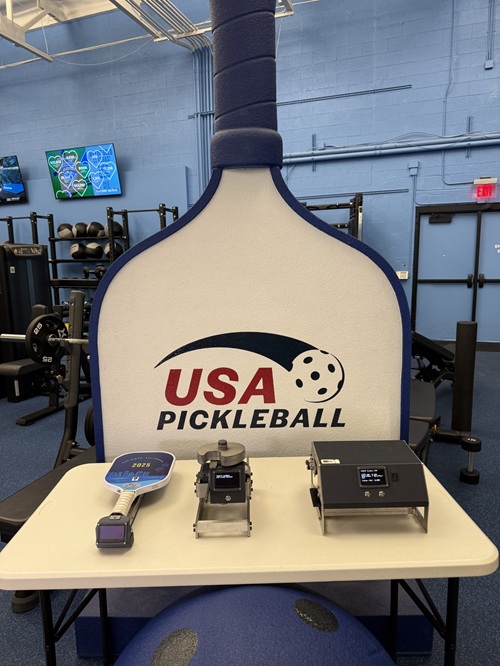
As inventory increases, USA Pickleball and Pickleball Instruments plan to make testing kiosks available at tournaments and clubs across the country, extending access to recreational and competitive players alike.
The equipment (a suite of three specific testing instruments) is portable; in fact, each piece is approximately the size of a laptop. A video that explains the testing process can be found here.
In future phases, additional performance data, including PBCoR and spin measurements, will be incorporated following completion of required laboratory certification.
The problem of counterfeiting in the sports event industry has been documented for years. There are multiple examples of items being manufactured quickly and sold online or in person, particularly in conjunction with a high-ticket sports event like the Super Bowl.
Recently, Promotional Products Association International (PPAI) covered the problem of corrupt online merchants hawking "official" Olympic merchandise and apparel. Scam campaigns were being run through Meta platforms such as Facebook and Instagram.
In addition to violating intellectual property rights, noted PPAI, scammers might not send anything at all and would instead simply harvest credit card information provided by purchasers provided by those who placed orders.
The problem continues because of widespread ignorance of the actual damage caused by the black market (examples can be seen in the comment section to this Instagram post); individuals may see only a low price while completely unaware of the ripple effect of counterfeiting:
It hurts American manufacturing: United States-based cap maker New Era reported losing $300 million a year in sales to foreign companies selling counterfeit baseball caps according to Buffalo Business First.
It undermines small businesses and the drive to buy domestically made goods: The growing wish to use “Made in America” products demands a need to make sure any items purchased are the genuine article, rather than something that comes more cheaply and is mass produced overseas. In fact, sources have noted that buying counterfeit products has a significant impact on the global economy, eliminating tens of thousands of jobs with legitimate businesses and costing the economy an estimated $600 billion of revenue a year.
It hurts workers: Counterfeiters who operate out of places like China are not accountable to human rights and environmental regulations nor do they adhere to child labor laws, anti-sweatshop laws or restricted substances laws.
Buying online from black marketers undermines legitimate sellers, including those who operate brick and mortar businesses.
It’s a crime. Really. Within the United States, a number of governmental agencies work to stop counterfeiting, and to secure intellectual property rights.
The purpose-designed website, StopFakes.gov, lists more than a dozen agencies, including Immigration and Customs Enforcement (ICE) and U.S. Homeland Security Investigations, all of whom have jurisdiction over different aspects of the problem.
In fact, Customs and Border Patrol (CBP), another agency involved, has an e-allegation portal through which people can provide information on suspected counterfeiting.
These issues are a view from 30,000 feet. USA Pickleball is zooming in to show the effect on a granular level.
Cheap Goods Don’t Help the Game: Pickleball has continued to evolve because of innovations in equipment. The more technologically advanced a paddle is, the better it is likely to play — and the more it is likely to cost because of the R&D that went into making it.
When a player tries to get around the $300 cost of a piece of quality equipment by paying $17 for something sold on Facebook, Temu, Alibaba or another platform, they might get something that looks like the high-end paddle but it will lack in quality and will not have the same play characteristics.
The black market for paddles "is having a detrimental effect on the sport," adds Burgess. This new effort, however, “is boots on the ground” in the war against counterfeiters.
"It gets the message out," he concludes.
About the Author