

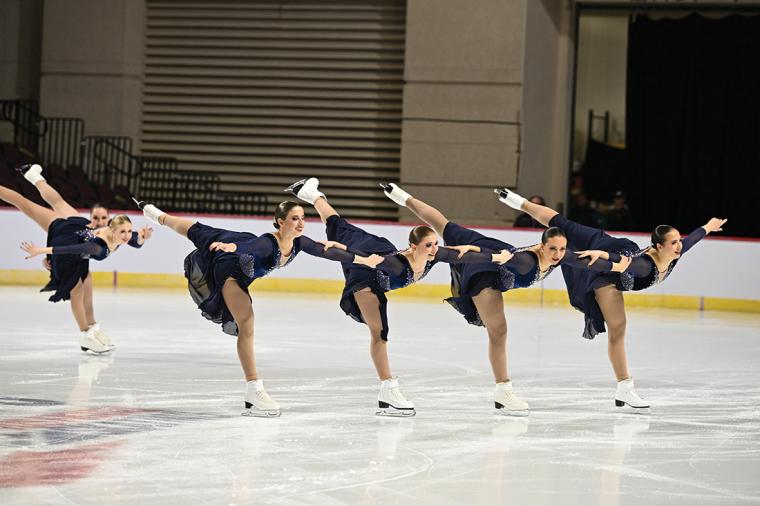
One of the disciplines of figure skating that is growing in recognition is synchronized skating. Whereas traditional figure skating disciplines are competed in singles or in pairs, synchronized skating (known colloquially as synchro) is a team-based sport.
U.S. Figure Skating held the first U.S. Synchronized Skating Championships in 1984 and the first World Synchronized Skating Championships in 2000. Today, there are about 600 registered synchronized teams in the United States.
Teams of eight to 20 skaters perform challenging formations and step sequences together, and competitions use the same judging system as singles, pairs and ice dance. As with other disciplines, all teams perform a free skate with required elements, while junior- and senior-level teams also perform a short program.
Synchro is not yet contested at the Olympic level; however, the International Skating Union (ISU) is actively working to have it included. Currently, ISU would like to see the discipline’s inclusion in the 2030 Winter Olympics in the French Alps, or perhaps in the 2034 Games in Salt Lake City.
Sports Destination Management caught up with Kyleigh Gaff, Director of High Performance Operations at U.S. Figure Skating, for information on the growing discipline.
Is Synchro its Own Spot?
Hypothetically, synchro is the fifth discipline of skating; the other disciplines that everyone is familiar with, having seen them at the Olympics as well as at other levels of competition, are men’s, women’s, pairs and ice dancing.
Who Participates in Synchro?
Synchronized skating is open to individuals of all ages and levels; information on the different levels can be found on the website at the address of www.usfigureskating.org/skate/skating-opportunities/synchronized-skating.
Teams can be co-ed or have members all of the same gender. That is a very cool aspect of the sport; there are no restrictions. It breaks barriers by allowing teams to be able to bring in those pairs elements like the death spiral. Skaters love that and so do the coaches. We also really enjoy seeing athletes being able to learn from one another and from other disciplines.
Synchro tends to attract well-rounded skaters who love performing the basic skills but who also enjoy being part of a team. One of the most important basics for success in this discipline is having athletes be able to switch their mindset from being the only person on the ice, or one of the only two people on the ice, to performing as part of a group.
Is Synchro Growing?
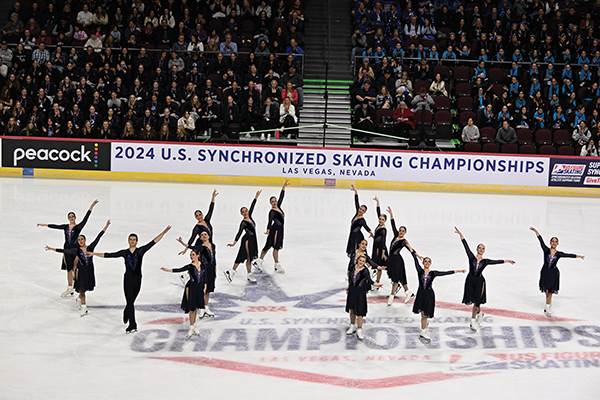
The number of teams has increased over the years. This is also a school sport; on average, we see about 32 active collegiate teams. Out of that number, there are three universities that have identified synchro as a varsity sport. We strive to educate all our clubs and organizations about the opportunities they have to become involved at all levels.
Something we want to do is raise awareness of the sport, so, of course, we’d like to receive more television coverage. Synchro is fun to watch; it’s fast and athletic but at the same time, you have athletes making these intricate shapes on the ice, resulting in really great and fascinating performances.
We are seeing a lot of our teams and clubs using social media to raise awareness of themselves and of the sport as well. If people see synchro being performed on TikTok or Facebook Reels, for example, that is the first step toward getting them interested in participating. Our website provides the next step, giving people the ability to find a team near them, or to locate a competition so that they can see synchro in person.
U.S. Figure Skating offers various levels of programming in synchro; within each level, various age groups can compete. More information on that is found on our site; however, the overall information is as follows:
• ASPIRE SYNCHRO: This is a Learn to Skate USA badge program designed for group classes. Aspire 1, Aspire 2, Aspire 3 and Aspire 4 are the beginning levels of synchronized skating that are offered at synchronized skating nonqualifying and Compete USA competitions.
• DEVELOPMENTAL LEVELS: Preliminary, pre-juvenile, open juvenile, open collegiate, open adult and open masters are offered. Teams can compete at any nonqualifying synchronized skating competition. These levels are offered at the U.S. Synchronized Sectional Championships.
• COMPETITIVE LEVELS: Juvenile, intermediate, novice, junior, senior, collegiate, adult, masters and senior elite 12 are offered. Teams can compete at any nonqualifying synchronized skating competition. They can also enter their respective sectional championships to qualify for the U.S. Synchronized Skating Championships. Top-performing teams at the junior, senior and senior elite 12 levels can earn the opportunity to be part of Team USA, with two teams going on to represent the United States at the ISU World Junior and ISU World Synchronized Skating Championships.
The Chance of the Sport Being Featured in the Olympics
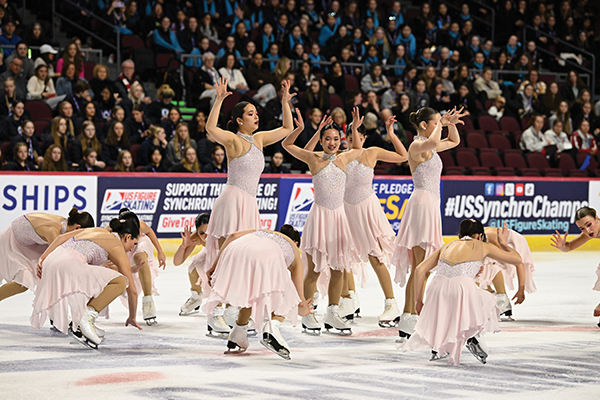
Obviously, we do not have answers yet but we certainly would like to see synchro added as a podium sport. The IOC is very focused on its quotas, meaning it has a goal for how many athletes it wants at the Games. Synchro teams generally bring 20 athletes each; of those, 16 are on the ice with four alternates.
Where is Synchro Most Popular?
The New England area is a hotbed for the sport. So is Chicago. Michigan is as well; in fact, the discipline was invented in 1956 in Ann Arbor, where it was called Artistic Skating and was first seen as intermission entertainment during University of Michigan ice hockey games. More of the historical information on the discipline can be found on our site.
Competitions Offered
Our website has information on competitive events, including downloadable documents listing competition calendars throughout various states. Information on how to find televised events can also be accessed by using our website.
Some notable upcoming events, including sectional, national and international championships, are as follows:
2026 Eastern Synchronized Skating Sectional Championships: Norwood, Massachusetts, January 12 through January 18
2026 Midwestern Synchronized Skating Sectional Championships: Plymouth, Michigan, January 19 through January 25
2026 Pacific Coast Synchronized Skating Sectional Championships: Highlands Ranch, Colorado, January 19 through January 25
2026 U.S. Synchronized Skating International Classic: Boston, Massachusetts, January 30 through 31
2026 U.S. Synchronized Skating Championships: Salt Lake City, Utah, March 4 through 7, 2026.
Events represent an opportunity to build exposure to the sport, as well as for destinations to make money and gain attention by hosting.
As the discipline of the sport continues to grow and innovate, we can expect to be hearing more and of course, seeing more. We look forward to these continued developments. SDM
About the Author