

Photo © Matthew Swartz | Dreamstime.com
The wheels of college sports rules turn slowly but they do, in fact, turn.
NCAA ice hockey rules committee members representing DI and DIII men and women are considering a requirement for cut-resistant equipment to be worn starting with the 2027-28 season. That means event owners need to be ready sooner, rather than later.
The change, as you will recall, was spurred by an on-ice incident in late 2023 when a former NHL player died after a skate cut to the throat while playing a game in England’s Elite Ice Hockey League.
It was as bad as it sounds — and yes, as much of a freak accident as it sounds. But then, so was commotio cordis, or chest concussion, which Damar Hamlin suffered, also in late 2023.
Within days of the event, a measure was passed by the English Ice Hockey Association (EIHA), noting that all ice hockey players in England would be required to wear cut-resistant neck guards (known in the business as Neck Laceration Protectors or NLPs) starting in 2024. It strongly encouraged the NHL to do the same.
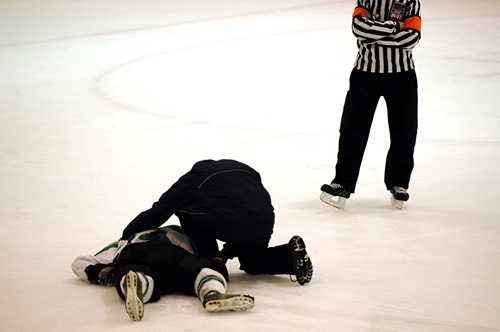
What followed was a will-they-or-won’t-they situation, with officials on both sides of the argument stepping away from the issue with any number of excuses as to why it was possible (or impossible) to enforce such a directive.
The NHL ultimately did change its rules, and will require neck protection of all players as of the 2026-2027 playing season. (And at the international level, they were required for all games in Olympic play this past winter.)
By mid-2024, USA Hockey had announced it would require neck protection for all players competing in youth, girls, high school or junior hockey within USA Hockey games and practices. In addition, on-ice officials under the age of 18 as well as players in all six disciplines within USA Hockey’s disabled hockey program are also required to wear NLPs.
For the moment, adult players are exempt from the rule; however, USA Hockey does recommend NLPs for adults as well.
The National Federation of State High School Associations (NFHS) also requires NLPs in competition. Further, it notes, NLPs most be worn "in their original manufactured state and as intended by the manufacturer."
According to this article, neck protectors are often worn incorrectly or even modified, by athletes or their parents. Trimming, cutting and taping neck protection are common methods (but there are others) and all generally result in a loss of efficiency for the devices.
The last card to fall has been that of collegiate hockey; however, according to NCAA, that is likely to change, and protection is expected to cover many other pulse points.
Under the proposal, the rules committees for all levels of men's and women's ice hockey are recommending that players wear protective equipment intended to protect the neck, wrist and ankle areas for the 2026-27 academic year. Current rules permit the use of this type of equipment.
The rules committees plan to examine the issue with manufacturers this summer with the goal of making this protective equipment mandatory by the 2027-28 academic year. Due to potential budget impact, Division III men's and women's programs could be given an additional year to implement the rule (2028-29).
The Division I Men's Ice Hockey Oversight Committee, the NCAA Women's Ice Hockey Committee and the Division II and III Playing Rules Oversight Panel must review and approve all rule proposals before they become official for their respective levels of competition.
The Division I Men's Ice Hockey Oversight Committee and the Women's Ice Hockey Committee will meet later this summer to discuss the ice hockey rules proposals. The Division II and III Playing Rules Oversight Panel will meet July 22.
"Some other levels of hockey have moved to mandate equipment intended to enhance student-athlete safety," said Trevor Large, chair of the Division I Men's Ice Hockey Rules Subcommittee and head men's coach at Canisius. "The committees at all levels believe this is an important step forward as our sport evolves."
Other rules under consideration — which event owners may need to familiarize themselves are as follows:
Bench technology
One topic that each of the rules subcommittees discussed thoroughly was the use of technology on the bench. The committees considered many possibilities and how tablets, etc., for coaching purposes would change the game. Ultimately, the committees decided to permit devices for audio communication and health and safety tracking but will continue prohibiting video for coaching purposes.
"There is not consensus on the use of video at this point," Large said. "The committees are supportive of ensuring both teams have access to equitable video feed, which we believe is a step in the right direction."
Embellishment/Diving
All committees reviewed potential options to enhance efforts to curb the concerning amount of embellishment and diving in the game. A variety of options were considered from a greater penalty to tracking players called for these fouls and potentially including a progressive penalty.
Ultimately, all groups strongly encourage conferences and coordinators of officials to call these rules as written more stringently in the upcoming season. Conferences that have focused on enforcement reportedly have seen some positive results.
Pucks played with a high stick
In women's ice hockey, the rules committees proposed that pucks could be played above shoulder height at any time in any zone of the ice.
Play will not be stopped, and goals scored by players above shoulder height will count under this proposal. The Western Collegiate Hockey Association experimented with this rule successfully last season.
Women's contact and overtime/shootout
In women's ice hockey, the committees worked together to enhance body contact rules and better define puck battles and expectations regarding contact and tactics. Numerous video examples were reviewed, and specific guidance will be distributed along with additional rules language to assist all in the sport.
The regular-season format for overtime will remain three-on-three for five minutes after a thorough review. If the game remains tied after the five minutes, conference policy will dictate if a shootout is used. It will no longer be mandated.
In nonconference games, the shootout policy is determined by the home team's conference. If the game is played at a neutral site, the shootout decision is determined by the designated home team's conference policy (or by in-season tournament policy).
"We believe the adjustments made this week will support and enhance the women's game as the sport continues to build momentum," said Mel Ruzzi, head coach at Brown and chair of the Division I women's rules subcommittee. "The ability to focus on our brand of hockey with these adjustments is a significant positive development."
Trapezoid area
Starting with the 2026-27 season, Division I men's ice hockey games will use a trapezoid area marked below the end line. Goalkeepers will be allowed to play the puck below the goal line in this area of the ice, but not outside this area toward the corners of the rink.
This aligns with National Hockey League rules and markings. Division III men's ice hockey will add this for the 2027-28 competition season to allow planning for this adjustment.
Other rule proposals:
- In NCAA women's ice hockey championship competition that uses video replay, all goals will be required to be cleared before play resumes.
- In men's and women's ice hockey, hand passes will be allowed in the defensive zone.
- In men's games, both players taking a faceoff must have the blades of their sticks flat on the ice before the puck is dropped.
- In Division I men's competition only, a timeout will not be permitted by a team that is not able to change its players (e.g., after an icing).
About the Author