

Photo © Wave Break Media Ltd | Dreamstime.com
According to the NFL’s own data, its “conservative and proactive approach” to minimizing head contact and reducing concussions paid off during the 2025 regular season with a record 538 in-game concussion evaluations and 26 medical timeouts. That said, the NFL still racked up 169 concussions throughout the season, up from 129 in 2024, Front Office Sports reports. Which is why the league continues to focus on equipment changes.
“Innovations in protective equipment are … central to these efforts, with more than 98% of players now wearing top-performing helmets,” the NFL noted in a February document detailing key season takeaways. “The pace of innovation is encouraging, and in the offseason, the league will prioritize facemask design improvements to match the advances made in helmet shell technology.”
Those facemask design improvements focus on “a crowdsourced competition designed to accelerate the development of cutting-edge football helmets and new standards for player safety,” ESPN reports. “The challenge invites inventors, engineers, startups, academic teams and established companies to improve the impact protection and design of football helmets through improvements to how facemasks absorb and reduce the effects of contact on the field. … Selected winners will receive up to $100,000 in aggregate funding, as well as expert development support to help move their concepts from the lab to the playing field.”
According to NFL data, 44% of in-game concussions in 2025 involved facemask impacts, compared to 29% in 2015.
"We’ve seen substantial improvements in the helmet shells over the last few years, but we have not seen a similar improvement in facemasks in their ability to deter some of these concussions,” Jeff Miller, the NFL’s executive vice president overseeing player health and safety, said at the league’s annual meeting in Arizona in April, referring to advancing technology of force-absorption helmets like Guardian Caps. “So when we have concussions on the field from helmet contact, a greater percentage of them are happening on hits right to the facemasks, and that piece of equipment does not have the same sort of force mitigation properties as the rest of the helmet.”
Guardian Sports, meanwhile, recently announced that the NFL has updated its 2026 Guardian Cap mandate, allowing all teams to choose between the Guardian Cap NXT and Guardian Cap NXT 2.0. This extension builds on the league’s use of Guardian Caps over the past four seasons to mitigate force reduction.
During that time, the NFL mandated their use in contact practices across preseason, regular season and postseason, expanded position requirements, and allowed players to wear Guardian Caps during games.
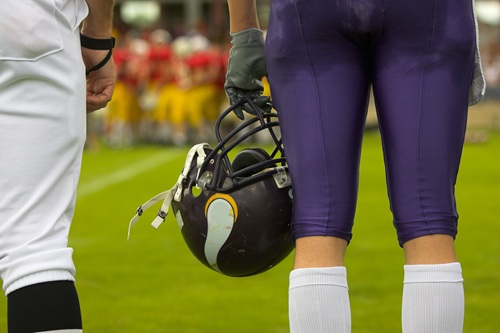
The Guardian Cap NXT 2.0 is a 12-ounce soft-shell layer of padding with the same materials and performance as the Guardian Cap NXT, the company said.
The NXT 2.0 also features a sleeker surface that allows for advanced customization and team branding.
Dozens of NCAA athletes used customized 2.0 Guardian Caps in games last season, company officials added.
All of which begs the question: What about youth football helmets?
As Youth Sports Business Report points out, “[i]f facemask design has lagged behind at the professional level, where equipment budgets are virtually unlimited, the gap is almost certainly wider at the youth level, where programs often rely on older equipment with tighter budgets.”
The good news is that a new NOCSAE standard specifically addresses youth football helmets; it was finalized in February 2025 and takes effect in September 2027.
The standard includes a maximum helmet weight of 3.5 pounds and impact performance specifications tailored for youth football players. Earlier this year, Riddell introduced its ND6 helmet line — named after NOCSAE Standard ND006.
“By introducing the ND6 helmet line more than a year ahead of the 2027 effective date, we’re … helping the football community access new helmet technology sooner,” said Thad Ide, Riddell’s chief product officer. “This early launch gives leagues, coaches and parents time to understand the new standard and begin transitioning to compliant Riddell helmets.”
“The NFL’s decision to crowdsource facemask innovation reflects a broader reality: [E]quipment alone cannot solve the concussion problem, but better equipment is a necessary piece of the solution,” added Youth Sports Business Report.
YSBR continues, “The league’s willingness to publicly identify the facemask gap is notable, and the data it published gives youth football stakeholders a concrete framework for evaluating their own equipment standards.”
The reportadd, “For youth sports businesses, the takeaway is practical. Parents are paying attention to these numbers. Leagues that invest in updated equipment, transparent safety protocols and age-appropriate programming will be better positioned to retain and grow participation."
And here's a wake-up call: "Those that don’t will continue losing ground to alternatives like flag football that carry a fundamentally different risk profile.”
About the Author