

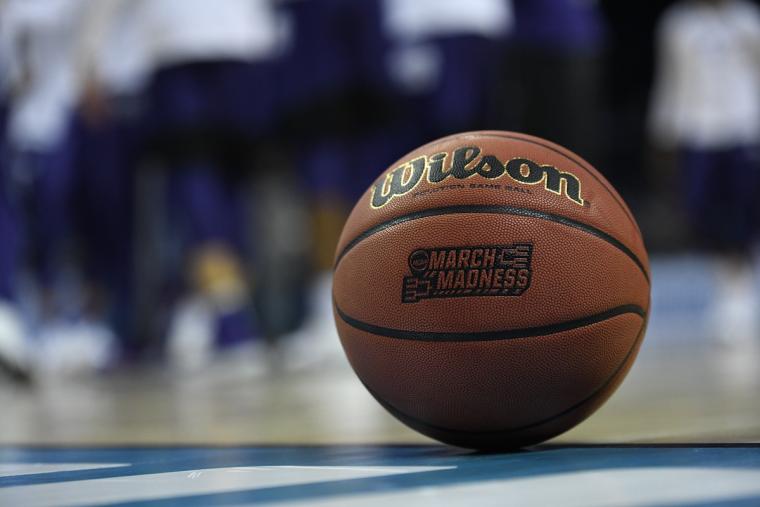
Photo © William Howard | Dreamstime.com
The first rounds of March Madness are set to take the floor early next week. That means cities nationwide will experience the transformation of indoor arenas to basketball courts.
Over the years, this process has become a science, helping venues do the quick changeover from being homes for ice hockey, monster trucks, bull riding and even rock concerts, to hardwood palaces that will showcase Division I athletes.
While most college fieldhouses are built with permanent wood floors (usually maple), a tournament floor, while equally high quality, is a completely different animal.
Last year, for example, the court used for the Sweet Sixteen games hosted in Indianapolis was not built board by board at Lucas Oil Stadium but instead, assembled from 262 panels of northern hard maple from the Upper Peninsula of Michigan.
The UP is the home of Connor Sports, who has been NCAA’s official court partner since 2006, and since this marks their 20th year making floors for the big dance, it’s to be expected that they have refined and streamlined their process.

”The floor you’re seeing right here actually came from sustainably harvested wood about a year ago,” Zach Ribery, the marketing director for Connor Sports, told reporters who came to watch the process unfold.
Once wood is harvested, reporters noted, it is shipped to a manufacturing mill, “followed by a team that puts the floor together in its raw form. From there, it heads to a facility in Ohio where all of the graphics are painted on and the stencils are matched with what the NCAA wants.”
A time-lapse video of the construction and marking of an NCAA March Madness court can be found here. It’s oddly hypnotic.
The completed court is disassembled and shipped to the appropriate arena to be installed by a crew of about a dozen people. The entire floor is 60′ x 120′ and weighs more than 42,000 pounds.
It generally takes less than four hours to assemble so that the arena is ready for tipoff. Want to see a video of that? Here you go.
The most essential aspect of the operation is having a stable and safe base for the court, upon which rests the subfloor. A court is only as good as what is under it, and creating a usable subfloor means striking the correct balance of shock absorption and resiliency.
As this article in Metro Atlanta Floors points out, “The subfloor becomes increasingly important when producing a high quality floor that is also portable.”
Portable indoor flooring is, of course, a fixture in the sports event industry at all levels and for all sports, and a wide range of products are used in settings like convention centers or multi-purpose indoor facilities:
Modular Systems are made of interlocking high-impact polypropylene tiles that snap together. Tiles are specifically engineered for performance sports.
Interlocking Flooring differs from the modular systems mentioned above in that pieces are flexible and fit together, either with a seaming tape or in a manner similar to puzzle pieces.
Rollout Systems are put down like a carpet; they can be rolled back up when not in use. An entire court may be on one roll, or the court may be in sections on several rolls that are seamed together with special tape.
Manufacturers offer systems in a variety of colors, often with custom logos and lettering offered.
In many cases, venues will purchase portable systems and rent them out as tournaments come into town. These surfaces are also popular in the “picklemall” sector, which has arisen from the conversion of empty big-box stores to pickleball clubs.
But for now, the conversation is all about basketball and at the moment, arenas nationwide are preparing to host their rounds of March Madness, which means NCAA-marked maple floors are being put into place, where they’ll host the biggest show this spring has to offer.
The wild ride runs from March 18 (for the women) and March 19 (men) to April 5 (women) and April 6 (men).
Of course, not every converted facility gets good press. In 2022, at the Las Vegas Invitational, women’s teams were taken aback to find their competition floor was set up in an out-of-the-way ballroom at the Mirage Hotel & Casino.
The resulting mess was roasted with photos like these illustrating the expectation-versus-reality difference between the promised facilities and what the women were actually given.
About the Author