

All photos © Luckydoor | Dreamstime.com
The National Federation of State High School Associations (NFHS), the governing body for high school sports and extracurricular activities, recently announced a change to high school baseball rules. Event owners for tournaments with high school age players should be aware of the new ruling and of the timing for implementation, and venue operators should take note as well.
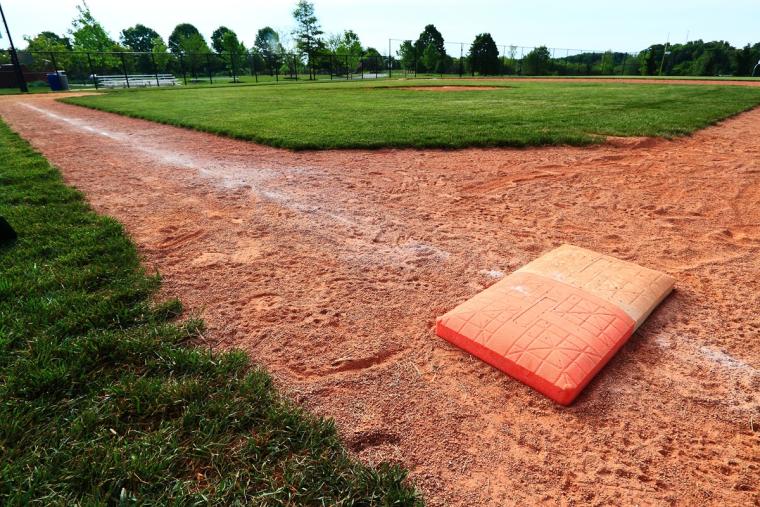
Beginning with the 2027 season, a double first base will be required in high school baseball games to minimize the risk of collisions by runners and fielders.
This change makes NFHS baseball rules consistent with those of softball; however, in the case of softball, a double first base is offered as an option rather than as a requirement. (For a double first base rule in softball to be required, it must be mandated by the state high school association; without being mandated, it remains optional.)
Event owners seem to agree with the change. Little League, for example, recently rolled out an announcement that they will be using the double first base at all their region and World Series events this year.
“Safety has, and will always remain, a top priority for us at Little League and as we think about ways to continue to enhance our event each year, the addition of a double first base provides a great opportunity for us to increase safety while not impacting the experience of our participants,” said Dan Velte, Little League Vice President of Operations and International Tournament Director. “With the use of the double first base becoming more prevalent in both the high school and collegiate level, the use of a double first base has become quickly adapted into the game, and we look forward to the enhancements it will provide to our teams throughout the summer as part of our events.”
"I realize it is a safety measure to try and cut down on first base collisions," notes Larry Thompson of Grand Slam Sports Tournaments, "and am 100 percent behind anything where the data that supports this."
Manufacturers on the market already offer double first bases; however, it is worth noting that modifications may need to be made to fields themselves in order to accommodate the new bases. The extent of modifications may depend on the type of base currently used, the level of play and the composition of the field (natural grass vs. synthetic turf).
As with any other bases, double first bases must be secured to the playing surface. Many are made to release in case of forceful collisions, or in case of the need to do maintenance on the field. Products on the market may be fastened down magnetically, with spikes or by other means, depending upon the product purchased and the type of field being used.
This rule revision was one of 10 proposed by the NFHS Baseball Rules Committee during its annual meeting held June in Indianapolis. The rules changes were accepted by the NFHS Board of Directors.
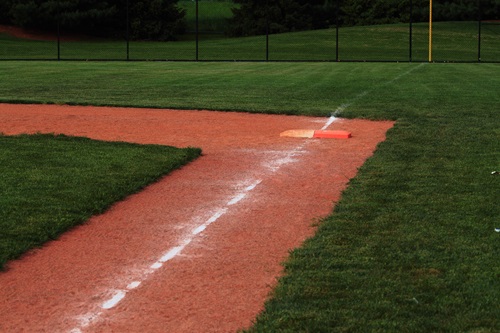
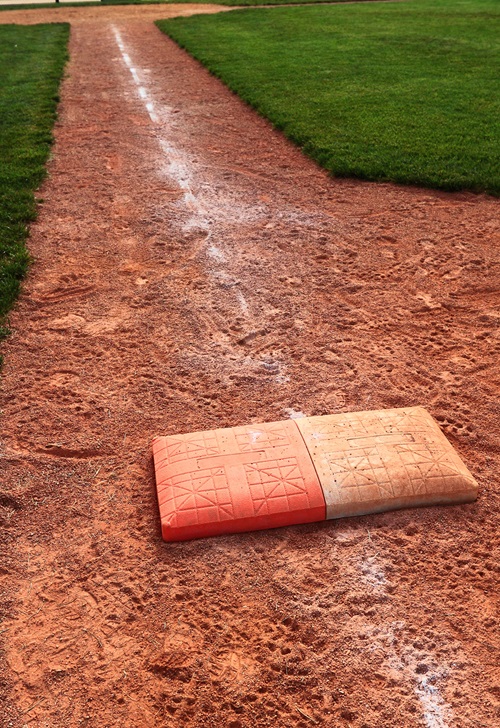 New language was added to Rule 1-2-9 noting that the double first base must be white and a contrasting solid color. The white portion of the base is located in fair territory while the colored half is located in foul territory, split by the first base foul line. (See the photos in this article for an example.) There is to be no space between the two portions of the double base.
"Adding the double first base is symbolic to the evolution of the sport. It will immediately address running lane violations, and it will further protect the players from the violent collisions that have occurred at first base,” said Elliot Hopkins, NFHS director of sports and liaison to the Baseball Rules Committee. “By reducing collisions and enhancing safety, it preserves both the integrity of competition and the well-being of those who play."
Several subsequent rules changes will be of interest to in-game officials. These include Rule 8-2-2a, which outlines how batter-runners and fielders shall use the double first base. The batter-runner should use the colored base on an initial play at first base unless a fielder is drawn into foul territory to receive a dropped third strike, in which case, the batter-runner would use the white portion of the base. Once the batter-runner reaches first base, the batter-runner must always return to the white base, including when leading off, returning on a pick-off attempt or tagging up on a fly ball.
A batter-runner may use either side of first base on a base-on-balls or on an extra-base hit to the outfield when there is no chance of a play to be made at first base.
Interference is to be called on batter-runners if they only touch the white portion on a force play at first and collide with the fielder. Similarly, it is obstruction if a defensive player only touches the colored portion of the base and collides with the batter-runner.
Another subsection of the rule, 2-5-1h, was added to note that it is a fair ball if a batted ball hits or bounds over any part of the white portion of the double first base. Alternately, it is a foul ball if a batted ball hits or bounds over any part of the colored portion of the base (Rule 2-16-1h).
Additional baseball rules should also be noted by event owners:
Rule 3-4-6 was added to address defensive player meetings as charged conferences. Each team, when on defense, may be granted not more than one player-to-player meeting during an inning. Umpires shall deny any subsequent defensive team requests for that half-inning. Additionally, Rule 2-10-3 was added to define a player-to-player defensive meeting as having two or more defensive players.
“A player-to-player defensive meeting is a natural and essential part of the game—whether it’s strategy, encouragement or clarification, but having multiple meetings in a half-inning adds additional time that lengthens a contest and is not in the best interest of the game,” Hopkins said. “A charged conference, however, involves direct coaching intervention with either a coach or a non-playing representative and is intended to provide instruction. The distinction ensures we honor both the flow of the game and the role of coaching.”
Two rules changes were approved to bring the Baseball Rules Book in line with all NFHS rules. Language added to Rule 1-4-4 allows a school’s name, nickname, logo, mascot and/or player’s name to be permitted on a uniform top and/or pants beginning in 2027.
In addition, Rule 1-6-3 states that “no player shall wear any audio (microphone) or video (camera) device during the game.”
A complete listing of the baseball rules changes will be available on the NFHS website at www.nfhs.org. Click on “Sports” at the top of the home page and select “Baseball.”
According to the 2023-24 NFHS High School Athletics Participation Survey, baseball is the fourth-most popular boys sport with 471,701 boys participating in 16,146 high schools across the country.
Note: NFHS regularly updates rules for boys’ and girls’ sports. Rules concern not just facility equipment or game markings but game play itself, as well as sportsmanship and the use of in-game technology. Announcements of new rules, or modifications of existing rules, are carried on the NFHS website at this link.
Additionally, an update was made to boys’ lacrosse; this change, which will go into effect in the 2026 season, is that cones are now required at the corners of the team areas (Rule 1-2-9).
About the Author