

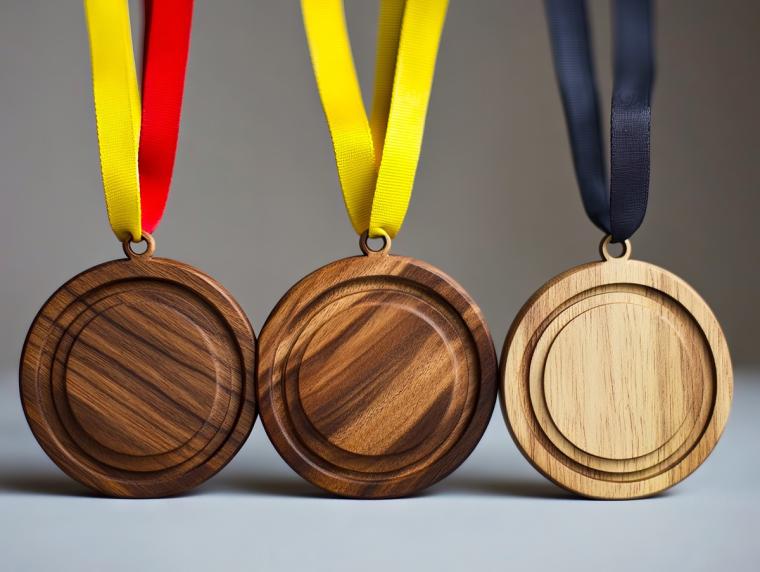
Photo © Volodymyr Pastushenko | Dreamstime.com
Wooden medals. Sounds odd, doesn’t it? But with the rise of awards being collected by athletes, a lot of hardware is being produced and handed out that may later need to be recycled (if not outright discarded by the recipients).
Note: This is NOT a commentary on participation medals, so put down your pitchforks and torches.
The uptick in hardware being handed out does, however, present a problem for event owners who are interested in sustainability, and who are looking for options that immediately speak to the eco-friendliness of an event.
While coverage has been given to trophies, medals and other awards that can be recycled, and to the programs that make that possible, some event owners are taking action by creating medals made of wood.

Global Art Gifts notes, “Wooden awards have emerged as a popular solution that reflects a commitment to sustainability while offering aesthetic appeal.”
The time is right to do this.
Randy DuTeau, who currently holds the position of executive director of Visit Mooresville in North Carolina, has a background in events, and used to be heavily involved with Own The Woods, a multi-sport trail fest, with mountain biking and trail running. His choice of eco-friendly merchandise made the event memorable.
“When it came to the swag for our event, we wanted to create something that stood out,” he told SDM in 2019. “Just about everyone has a drawer full of big metal medals strung on beautiful ribbon – and those are great – but we wanted to set ours apart. Staying with our Own the Woods theme, we created medals that were made out of wood and tied with a piece of twine. They were really well received and were a great extension of our theme.
Plaques for winners were made of wood as well. We’re pretty sure those will stand out in anyone’s trophy case. They’re really high-quality but at the same time very unique; there’s nothing cheap or chintzy about anything we handed out.”
However, not all wood awards are equal in terms of recyclability. Those made out of plain, untreated wood (meaning not painted, varnished or pressure treated) are seen as recyclable and sustainable, while others may not be.
Additionally, some awards, such as those made of mixed media (such as glass, Lucite or wood plaques with metal embedded in them) don’t fall into any one category, and need to be disassembled to be sustainable, something that presents a challenge in recycling programs that are already overburdened nationwide.
“While many Americans dutifully put items into their recycling bins, much of it does not actually end up being recycled,” said researchers at Columbia University.
As a result, wooden awards (meaning just plain wooden awards, no additional elements) are coming into their own, thanks to their eco-friendliness. Josh Ellis, publisher and editor-in-chief of Promotional Products Association International (PPAI) Media, says sustainability is a strong focus now, and one that is growing.
“I don’t have hard data on the rise of wood or recycled materials in awards or trophies, specifically, but I can tell you it’s a product specialty that our industry’s awards suppliers have covered. For instance, PPAI itself elects to use wood for our own PPAI 100 trophies, which go to companies exhibiting industry leadership on numerous grounds, including sustainability and corporate responsibility.”

Additionally, he notes, it’s just plain good publicity for those who do choose this type of award.
“It does help make a sustainability statement, which can be subtle or more apparent, depending on how direct the award presenter chooses to be in communications. Many times the storytelling that supports a piece of branded merch goes farther than the physical item itself.
There are over 1 million products available through our industry, so there is something for every brand to make almost literally any statement it desires. Industry distributors are prepared to offer sustainable options, and often advise them as a first choice. But ultimately, it is a client decision of whether to prioritize eco-friendly materials. Luckily, the costs to do so are trending downward.”
PPAI has found that consumers have an interest in the ecological impact of their products; in fact, the organization’s Product Power consumer research for 2026 revealed as much:
- 76% of consumers say sustainability influences whether they keep or use a product.
- 49.3% say it increases their trust in the brand behind the item.
- More than 62% prefer products made from recycled or eco-friendly materials.
- 27.9% say a product that is perceived as “not sustainable” feels cheap or low quality.
However, those consumer sentiments are not necessarily lining up with buyer requests, at least according to PPAI’s 2025 distributor research:
- Only 33.3% of distributors say clients regularly ask for sustainable options.
- 54.2% say environmental, social and governance (ESG) or product origin questions are still rare.

But overall, the trend is growing. Do a quick Google search of “wooden award medals” and you’ll find literally hundreds of them from vendors nationwide (and worldwide).
Another plus: Wooden medals cost less to ship, particularly when bulk orders are needed, says this piece of content contributed to Running USA.
“Wooden medals have come a long way from their eco-novelty beginnings,” the article states. “Today, they’re a smart, modern alternative to traditional metal awards; combining customization, affordability and environmental responsibility. They may not shine like gold or enamel, but they bring something better: warmth, character and meaning.”
About the Author