

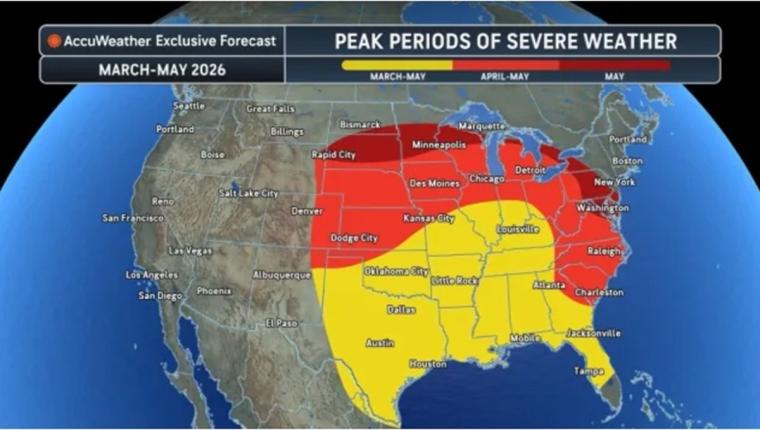
Image courtesy of AccuWeather
The long-range weather forecast for this spring is in and it should be reassuring to owners with sports events planned for areas in the Midwest: fewer tornadoes are anticipated.
According to meteorologists at AccuWeather, the 2026 severe weather season is shaping up to be markedly different from last year’s exceptionally active spring, which had hundreds more tornadoes compared to the historical average.
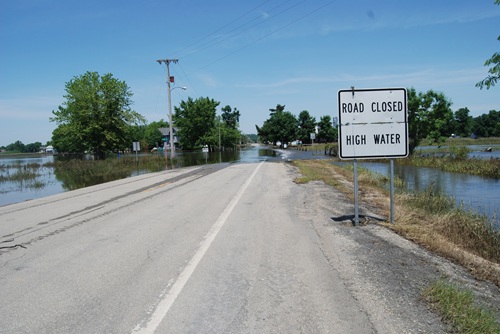
While tornado activity is expected to trend lower this year compared to 2025, the risk will shift toward more frequent and heavier downpours, flooding and damaging straight-line wind events across parts of the country.
“There may be fewer tornadoes reported compared to last year, but that does not mean this will be a quiet severe weather season," AccuWeather Meteorologist Alex Duffus explained. “There is an increased likelihood of severe thunderstorms packing damaging wind gusts and heavy downpours. Flash flooding is a big concern this year.”
The AccuWeather 2026 U.S. Severe Weather Forecast predicts an increased risk of severe weather episodes across the eastern Plains into the mid-Mississippi Valley and western Ohio Valley in March and April.
Cooler, more stable air may limit severe storms farther north early in the season, before conditions become more favorable in late April and May.
“Do not let your guard down this severe weather season,” Duffus warned. “Flash floods and damaging wind gusts can be just as destructive as tornadoes and often impact a much larger area.”
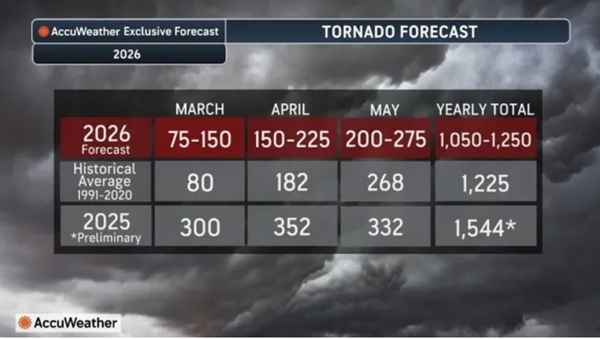
AccuWeather long-range experts predict 1,050 to 1,250 tornadoes across the U.S. this year, compared to the 1,544 preliminary tornado reports in 2025. The historical average for tornadoes in the U.S. is 1,225.
While those numbers sound alarming, it is essential to keep things in perspective. According to the City of Brownsville, Texas, “Most tornadoes are just a few dozen yards wide and only briefly touch down.”
However, the article notes, it is the highly destructive violent tornadoes that get the attention, and “although violent tornadoes comprise only two percent of all tornadoes, they are responsible for nearly 70 percent of tornado-related fatalities.”
AccuWeather’s tornado forecast predicts roughly 20 to 30 percent fewer tornadoes this year across the U.S., compared to 2025.
An exceptionally warm spring with plenty of moisture last year produced a high tornado count and several major severe weather outbreaks, with nearly two-thirds of the year’s tornadoes occurring from March through May.
States facing a higher risk of storms with hail this spring include parts of Texas, Oklahoma, Arkansas, Louisiana, Tennessee, Mississippi, Alabama, Missouri, Kansas, Nebraska, Iowa and Illinois.
Factors Driving Severe Weather Patterns in 2026
AccuWeather long-range experts point to exceptionally warm waters in the Gulf again this year, which can act as fuel that intensifies storm outbreaks when the timing is right.
The large-scale pattern is forecast to evolve quickly. The El Niño-Southern Oscillation (ENSO) is expected to trend from neutral toward El Niño by summer.
A fast exit from La Niña could result in a weaker upper-level jet stream overall this spring.
This can reduce the frequency of atmospheric setups that can produce tornadoes, while still supporting organized lines of thunderstorm capable of producing damaging winds and repeated rounds of flooding downpours.
AccuWeather climate experts note that shifting precipitation patterns are increasing the odds of extreme rainfall events and flash flooding.
While average annual rainfall across the contiguous United States has declined by 2.7% since 1995, the frequency of extreme rainfall events exceeding 4 inches in 24 hours has increased by 70 percent, according to an AccuWeather climate study released in January.
Shifting Severe Weather Risk Zones This Spring
March will likely bring multiple rounds of severe weather but not to the level seen in March 2025. The jet stream that often helps focus repeated severe outbreaks may retreat north earlier than last year.
“The risk for tornadoes and severe weather in March and April will likely be focused across the eastern Plains into the mid-Mississippi and western Ohio valleys,” Duffus said. “Cooler air will likely limit severe weather farther in the northern Plains and Midwest until late April and May."
AccuWeather long-range experts say an uptick in tornadoes is likely later in May farther to the west in the Plains, known as Tornado Alley.
In general, say meteorologists, it is wise to review insurance coverage and make sure information on storm shelters, evacuation routes and designated safe spaces is communicated clearly well in advance of any sports event.
About the Author