

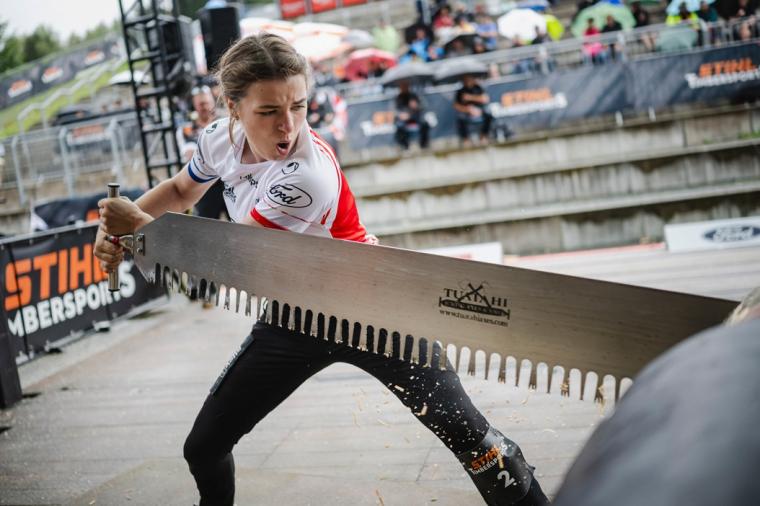
All images property of STIHL TIMBERSPORTS®
At one time, women in lumber sports (the working nickname is “lumberjills,” as opposed to lumberjacks) were thought of as, ahem, a splinter group.
Today, they’re a towering force in their industry, comprising nearly 50 percent of the field in a recent competition and drawing a fan base of followers who consume content in person and online with near-rabid interest.
“We’re really excited about how much that division of the sport has grown,” Roger Phelps, Corporate Communications Manager, STIHL Inc., told SDM in an interview in 2019. “In 2017, [STIHL TIMBERSPORTS®] had our first women’s championship.”
Since that time, adds STIHL's Christopher Borghorst, "we’ve seen a clear and exciting increase in the number of women involved in TIMBERSPORTS®, both on stage and in the stands. The number of registered female athletes has grown significantly, with nearly 100 women from 16 countries now competing in the Series. Over the past decade, the number of women’s competitions has increased by more than 200 percent, and the level of performance has risen dramatically. Just recently, the 2025 U.S. Women’s Championship saw three new world records, underlining the incredible progress and professionalism of female athletes in the sport."
This growth, he adds, "is also reflected in the fanbase. Our event audiences have always been diverse, often including families with children, which creates a welcoming and inclusive atmosphere. On social media, our community has traditionally been male dominated, but we’ve observed a positive shift in recent years, with more women engaging with the sport and its athletes online."
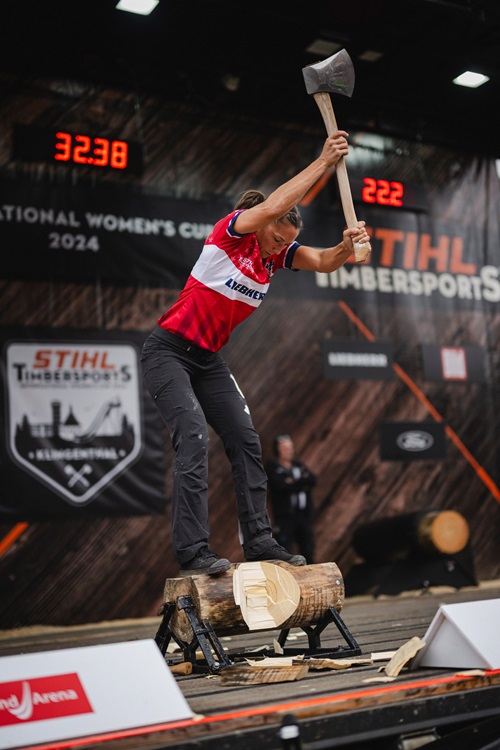
The number of women in the sport continues to climb. In late July, the 65th Annual Lumberjack World Championships, held in Hayward, Wisconsin, drew the attention of NPR, whose reporters noted the nearly 50/50 ratio of male to female competitors. Athletes, the article noted, came from 16 states, Canada, Australia, Ireland, the Czech Republic, Spain and Wales to participate.
Events contested by women vary. For example, in STIHL TIMBERSPORTS®, the women’s competitions include Stock Saw, Standing Block, Single Buck and Underhand Chop; in other words, those relating to equipment.
In the Lumberjack World Championships, women compete in All-Around, Relay, Axe Throw, sawing events and chopping events. Also at the Wisconsin competition were some non-chopping/sawing events that had their roots in the lumberjack profession, including log rolling and boom run (both contested on water); the latter two competitions also have youth divisions.
By the way, the Lumberjack World Championships is all about the involvement of those who don’t wield axes or saws but want to take part in the festivities; one event is the Lumberjack Run, with awards for best costumes. The website notes, “Tour the streets of Hayward on a fast and fun course that is great for running, walking, or both. Show us your lumberjack-est, woodsy-est costume and be entered for a chance to win a free entry to a Birkie event.”
Instagram photos from the run showed participants wearing race attire including logging hats, fake beards and lumberjack shirts cut in various ways to facilitate running. Information on the 2026 event is already online.
So where do lumberjills (and woods sports professionals in general) come from, anyway? According to Roger Phelps of STIHL, colleges that offer majors in forestry or horticulture are
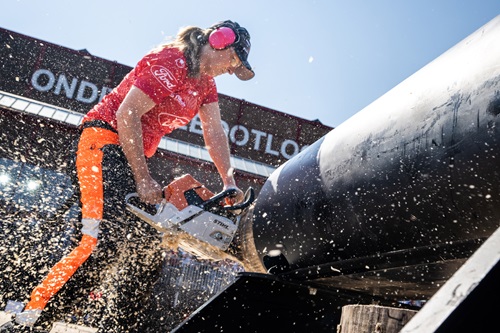
fertile ground for the next generation of athletes, since many of those institutions will have a research forest and will be connected to logging companies or paper mills.
But, he added, the sport is not about swinging axes and cutting down trees.
“Today’s professional logger is just that – a professional. Professionals are using sustainable forestry practices, and they can be as low-tech or as high-tech as needed.”
And let’s face it: This is absolutely not a “Hold my beer” sport.
“We like to say it’s the original extreme sport, and it really is,” Phelps noted. “We have people who are climbing up a tree and chopping the top off or swinging an axe between their feet – you have to know what you’re doing.”
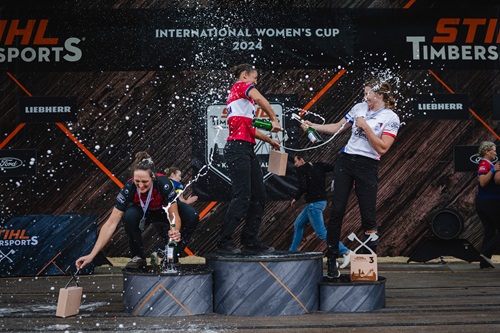
The USA’s Erin LaVoie is a rockstar in the lumber sports world. She has won the STIHL TIMBERSPORTS® International Women’s Cup in back to back years (2023 and 2024) and the same organization’s U.S. Women’s Pro Championship in 2024 and 2025. Other American women of note in the wood sports sector include Kate Witkowski, Laura Berman and Samantha King. They routinely face off not only one against another but against athletes like Karolina Urbanová (Czech Republic), Tove Njåstad (Sweden) and Alrun Uebing (Germany), as well as a host of others.
Catherine Eccles, a lumber sports athlete in the U.K., is quick to cite the heritage of the industry and the role women played.
“You would think that the sport is more masculine or a more male-dominated sport,” Eccles told a reporter from the Daily Mail. “Dating back to World War II, men went to war and the women went to work the land. So, the women that went to work in the woods; that was where the lumberjills came from as we had to pick up that slack when the guys went to war. So as much as it is a masculine sport, there's no reason for women not to be involved in it, given that for such a long period of time, women did work the land.”
Of course, says Nancy Zalewski, a longtime competitor, bringing in the next generation is a challenge.
“Unless your parent does it, it’s not something you are going to do,” Zalewski said. “Kids are going to pick up a basketball or a soccer ball. They’re not going to say, ‘Hey, kid, here’s something sharp, let’s teach you to swing it between your feet.’ They have to see someone else doing it.”
About the Author