
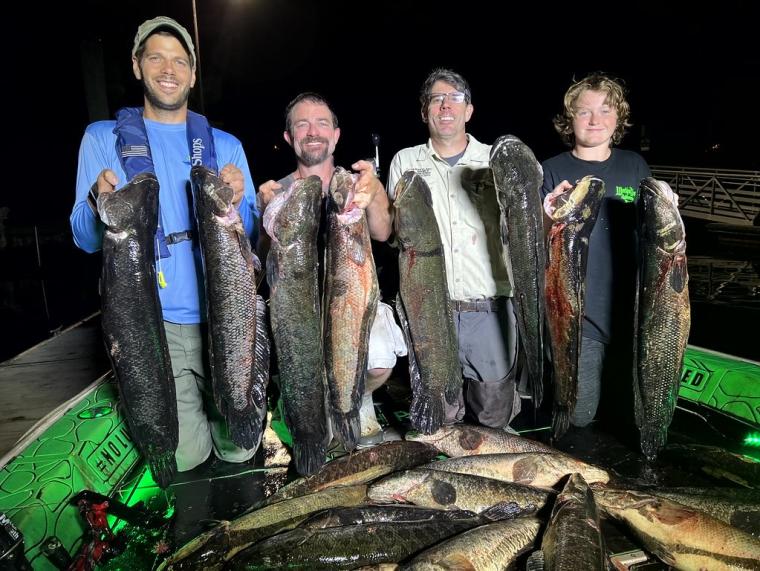
Maryland DNR biologists Joe Love (second from right) and Dan Goetz (second from left) worked with Captain Nick Mather (left) of Working Class Outdoors to harvest 23 northern snakeheads as part of its collaborative project with the U.S. Fish and Wildlife Service. The team is working to learn more about how bowfishing is helping to control the invasive predator’s population. Photo courtesy of Maryland Department of Natural Resources
The Maryland Department of Natural Resources recently released a report that bowfishing and gigging (using a pronged spear) had become popular and effective tools in the state’s fight against the Northern Snakehead, an invasive fish.
These methods eclipse hook-and-line, commercial and departmental management harvest of the invasive fish. It even beats out the incentives to anglers provided by bounties Maryland has put on the fish.
The study, published in Integrated and Comparative Biology, also found that bowfishermen are successfully removing larger, more fecund females (those with more eggs) than traditional anglers, a key factor in limiting population growth.
“Bowfishing is an important component of the fishery, annually removing approximately 20 percent of the[snakehead] population in the upper Chesapeake Bay,” said study author and DNR biologist Dr. Joseph Love. “We are always looking for creative, responsible ways to get us closer to our needed targets for managing these populations.”
The fight against invasive species rages nationwide and bowfishing is ramping up in popularity.
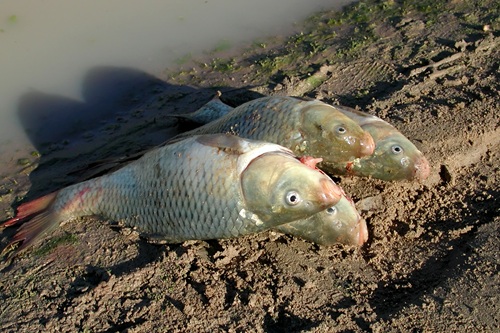
In South Dakota, for example, bowfishing has emerged as a popular means of controlling Asian carp. (Like snakehead, carp are a wily species and are hard to trick into going after a lure or bait.)
Bowfishing is a niche aspect of the event market as well, with tournaments taking aim (see what we did there?) at invasive species; in fact, many bowfishing tournaments will consider only invasive species (rather than game fish like alligator gar, catfish and spoonbill) for anglers’ bags when counting weights and some tournaments include lie detector tests to ensure that only invasive species were targeted.
Most common fish weighed at tournaments (in areas where snakehead are not a concern) include common carp, grass carp, silver carp, bighead carp, buffalo, long nose gar and suckers.
The 2026 Bass Pro Shops U.S. Open Bowfishing Championship, with more than $100,00 in cash prizes, will be presented on May 2 and 3 on Missouri’s Table Rock Lake and Bull Shoals. The Bowfishing Association of America heads to Arkansas on July 24 for its BAA World Championship.
Regional events are also attracting bow anglers. In Louisiana, the 13th annual Cajun 8 Bowfishing Tournament will run in August. In May, Kentucky Lake on Tennessee offers its Kentucky Lake Bowfishing Series: Captain’s Choice.
But the discipline is not without its detractors. On Minnesota’s Lake Minnetonka, recreational bowfishing was allowed in 2025 for the first time in 10 years — and neighbors weren’t happy, despite the fact that only four bays (Harrisons Bay, West Arm, Halstead Bay and Jennings) would see action.
The reason was simple: Bowfishing is often conducted at night, and Lake Minnetonka’s bow anglers were among those following that pattern. Advantages to night bowfishing are numerous (this article lists them in detail, but in short, it’s cooler at night, fish are closer to the surface and there is no glare on the water).
But that means those living in close proximity to the lake were dealing with lights (special boat lights are needed for bowfishing at night), noise and increased traffic. Pushback from neighbors followed but after reviews and discussion, it was decided the benefits outweighed the drawbacks, and bowfishing again will be allowed on Lake Minnetonka this year, and on the entire lake, rather than only specific areas.
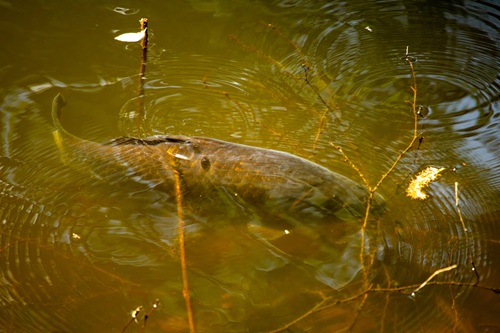
At the same time, there is concern about the negative impact of the lack of regulations around bowfishing. As opposed to snakehead, which are a delicacy and which can be cleaned by the angler or sold for their meat, carp is not considered marketable in the U.S.
Unlike tournaments, recreational fishing has fewer regulations governing disposal of such catches. As a result, in many areas, hundreds of pounds of dead carp were being dumped back into the water, in nearby trash cans or dumpsters or into nearby woods, creating their own set of problems.
In some cases, change is afoot to try to move some harvested fish into market. In Maryland, for example, legislation introduced last summer is intended to establish a pilot program in the NOAA Chesapeake Bay Office to facilitate a market for Chesapeake Bay blue catfish in the pet and animal food industry in an effort to take millions of pounds of these harmful fish out of the state's waterways.
Under the program, NOAA will administer grants to pet and animal food manufacturers to ensure watermen are properly incentivized to catch blue catfish and establish transportation, processing, and manufacturing structures for a long-term market. Throughout this two-year pilot, NOAA will collect data on the ecological and economic impacts of this program. NOAA will then report best practices, lessons learned and recommendations to Congress.
Despite the fact that little economic impact data exists for invasive species bowfishing tournaments and invasive species bowfishing in general, there is ample evidence of the need for them.
Research published in 2025 by Springer Nature Link noted that by 2020, U.S. federal and state agencies had spent nearly $592 million in cumulative management costs trying to control bighead and silver carp.
That same report noted that a benefit transfer analysis of invasion effects on total economic value of recreational fishing, an important ecosystem service, in a heavily invaded section of the Illinois River, estimated a total loss of more than $10 million over 10 years.
About the Author