

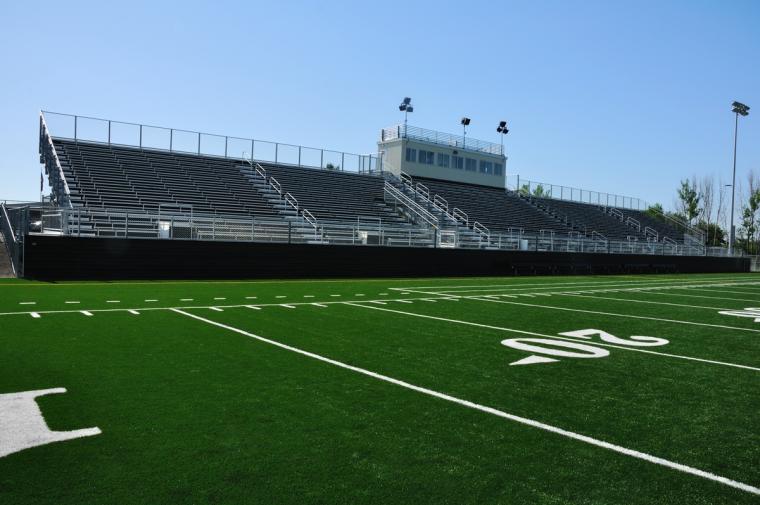
Photo © Mark Herreid | Dreamstime.com
The fastest developing sport at the high school level, flag football, just keeps right on evolving. Last summer, the National Federation of State High School Associations (NFHS) released its first set of rules.
Only eight months later, changes to those rules have been announced, including a fourth playing field configuration and the option for instant replay as well as alterations in rules around the number of players who can be on the field during the game.
Event owners, rights holders, tournament directors and venue managers should be aware of these alterations now, as NFHS will implement them in the next academic year.
The changes were announced following the meeting of the NFHS Flag Football Rules Committee, held in late January. Eight changes in all were approved.
All revisions recommended by the committee were reviewed by the NFHS Rules Review Committee and subsequently approved by the NFHS Board of Directors.
Field of Play
Among the revisions were three changes in Rule 1 – The Game, Field, Players and Equipment, two of which are by state association adoption.
Beginning in 2026-27, states will have a fourth option for the size of the playing field: 300 x 160 feet.
Three configurations of were announced previously and all field information is currently posted on the NFHS flag football page, an incredibly robust listing of resources.
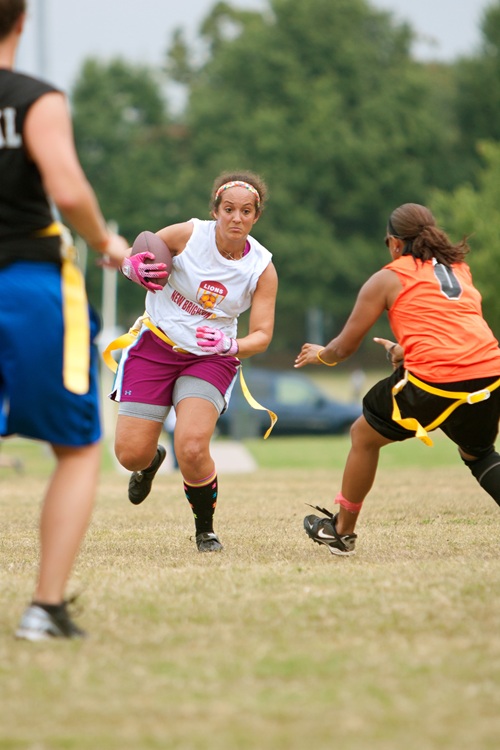
The three field sizes previously announced were as follows:
- 120 ft. wide x 240 ft. long
- 120 ft. wide x 300 ft. long
- 160 ft. wide x 360 ft. long
Each field size additionally has two 30-foot end zones.
States using NFHS rules are able to choose which of the four fields they want to designate as their official field dimensions.
The reason for having multiple field sizes, Bob Colgate, NFHS Director of Sports and Sports Medicine, told SDM last summer, was that with so many states currently offering flag, differing field sizes had been used. NFHS wanted “to make the transition [to having rules] as easy as possible.”
Since in many cases, high schools have turf fields, cones can be used to designate the sidelines, end zones, etc. Grass fields, notes Colgate, can be marked for flag football at the discretion of the athletic director.
Instant Replay
Another rule revision by state adoption is a note to Rule 1-3-7, which will offer states the option of instant replay during state postseason games only.
Play Format
The rules committee continued to support the seven-player game for high school flag football, but a change was made to Rule 1-1-3, stating that each team shall begin the game with seven players, but if a team has no substitutes to replace injured or disqualified players, it may play with no fewer than five.
Additional Rules Changes
Among the revisions recommended by the committee was an exception to Rule 8-3-9, which will allow the team trailing in score to keep possession of the ball following a try. If it so elects, the trailing team will take possession of the ball, fourth down at its own 20-yard line.
Normally, after a try by the scoring team, the opponent receives the ball at its own 14-yard line. This opportunity to retain the ball is an attempt to mirror tackle football, which provides the scoring team the option of an onside kick to retain possession of the ball.
“Following thorough experimentation in multiple states, the committee is excited to introduce flag football’s version of an onside kick,” said Tyler Cerimeli, chair of the NFHS Flag Football Rules Committee and director of athletics and officials for the Arizona Interscholastic Association. “This will allow a team that is trailing the opportunity to run a high-risk play in order to retain possession and facilitate a potential comeback.”
Another change approved for high school flag football in 2026-27 involves restarting play following a safety. Next year, following a safety, the team whose goal line was involved shall put the ball in play by scrimmage kick from its own 20-yard line. In the first set of rules last year, the team whose goal line was not involved put the ball in play by snap from its own 30-yard line.
Colgate said the committee made this change to create a more significant field position advantage while also becoming consistent with tackle football.
In Rule 2-18, the committee approved a new definition for hurdling as follows: Hurdling is defined as “an attempt by a player to jump (hurdle) with one or both feet or knees foremost over an opponent who is contacting the ground with no part of their body except one or both feet.”
Colgate said the committee added this definition because it was not previously defined but was listed as an illegal personal contact foul in the initial rules book last year.
The final changes include one to Rule 3-5-1, which increases the total number of charged time-outs per half from two to three, as well as a revision to Rule 9-7-4, which clarifies what cannot be done to the ball that is in player possession.
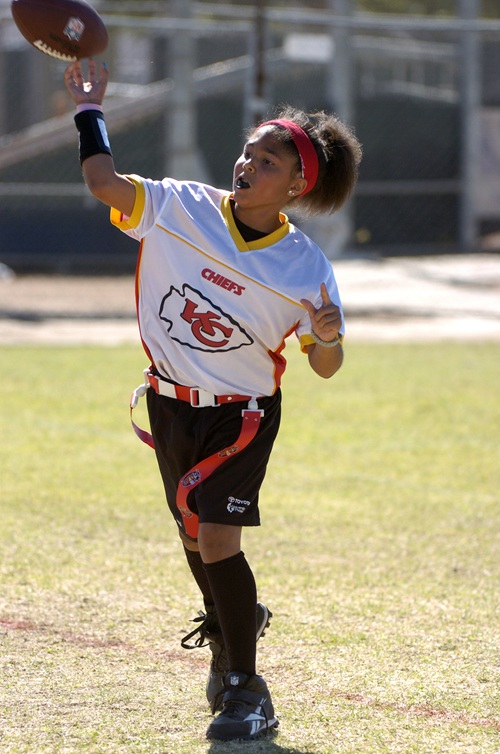
Article 4 now states that a ball in player possession shall not be batted, stripped or attempted to be stripped by punching, striking or grabbing the ball by a player of either team.
A complete listing of the flag football rules changes will be available on the NFHS website at www.nfhs.org. The page devoted to flag football can be accessed at this link.
Timeline for New Rules
The updated print version of the 2026-27 Flag Football Rules Book will be available for purchase in late May at www.NFHS.com, and the digital version will be available in May via NFHS Digital at www.NFHS.org.
Flag Gaining Yardage Nationwide
Currently, 17 state associations have sanctioned girls flag football, with six additional states voting on sanctioning in 2026, and 15 states are involved in independent/pilot programs at some level.
States that have sanctioned the sport for girls include NFHS member associations in Alabama, Alaska, Arizona, California, Colorado, Connecticut, Florida, Georgia, Hawaii, Illinois, Mississippi, Nevada, New York, Ohio, Pennsylvania, Tennessee and Washington. The Louisiana High School Athletic Association will begin sanctioning the sport in 2027.
The six state associations voting in 2026 include Oregon, Kansas, North Carolina, New Jersey, Rhode Island and Maryland.
State associations with independent/pilot programs include Delaware, District of Columbia, Indiana, Kentucky, Massachusetts, Michigan, Minnesota, Missouri, Montana, North Dakota, Oklahoma, South Carolina, Texas, Virginia and Wisconsin.
According to the 2024-25 NFHS High School Athletics Participation Survey, a total of 68,847 girls participated in flag football in 2,736 schools nationwide.
About the Author