

Photo © Jian Zhang | Dreamstime.com
Recently, Running USA announced it had integrated AllTrack music licensing into its platform of music licensing offerings for event producers. It was just the latest offering to help safeguard event owners and managers, since playing music at public events requires licensing under U.S. copyright laws.
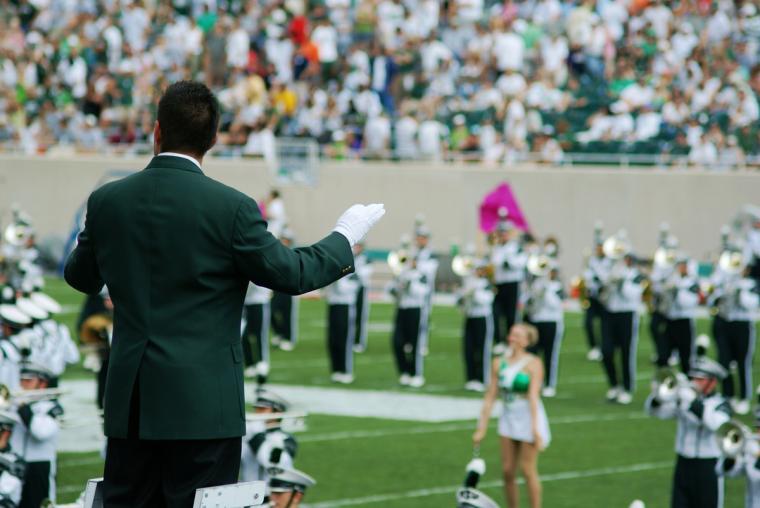
But those laws don’t just extend to afterparties at running events or music played before the starting gun goes off or along the course. They also cover warm-up music played at basketball games, background tracks to gymnastics events, performance soundtracks at cheer competitions and even popular sing-alongs played during the seventh inning stretch, as well as a multitude of other uses.
According to copyright law, any public performance of music requires permission from the writers and publishers. That goes for live music by a band or DJ or even recorded music played off a CD, iTunes or even an online streaming service. (One summary, on the website of the National Federation of Independent Businesses, can be found here.)
Admittedly, it’s not always intuitive. The National Federation of State High School Associations (NFHS) notes, “Copyright compliance can be a confusing topic with all of its intricacies and nuances. Ensuring that live music at an athletic event or other activity and any use of recorded music is copyright law compliant can be a challenge. If you choose to record or stream the ball game (including the music being played/performed) the situation gets even more complex.”
NFHS created its own guidance document in partnership with the National Association for Music Education (NAfME) and it can be found here.
The problem, however, is that enforcement is uneven and there's a lot of misinformation circulating about what can and can't get a user in trouble. NFHS has some scenarios listed at this link; however, these are examples and not a full listing of all situations.
For those whose eyes have already glazed over, resources are available. Many national governing bodies and larger event owners, as well as industry organizations, offer their members guidance on music licensing, and in many cases, opportunities to use specific licensing platforms.
Note that no NGB or sports organization considers itself a clearinghouse for blanket permission to use an unlimited amount of material, and that membership in any NGB or organization likewise does not imply permission to use music.
The following organizations are among those who have information and resources available in the interest of helping event owners:
- USA Cheer has a robust music information page that lists copyright education and music providers, as well as other information. (Varsity Spirit offers resources as well.)
- The United States Olympic and Paralympic Committee (USOPC) has created a PDF, entitled, “Music in Sport: Guidance for Athletes,” available at this link.
- The NFL’s music site includes music which is available to be licensed for all media. Access to the site provides users with a wide range of music selection and licensing options.

Photo © Gerry Boughan | Dreamstime.com Road Runners Club of America has negotiated a simple and cost effective group music license with performing rights organizations (PROs), BMI (Broadcast Music, Inc), American Society of Composers, Authors, and Publishers (ASCAP), Global Music Rights (GMR) and AllTrack.
Those are just a few examples of music licensing at the sports event industry level. Here is one article detailing individual instances of music licensing by Major League Baseball, where players select walk-up music and where teams might have specific songs played to amp up the crowd at strategic points during the game.
It’s still okay if all this is as clear as mud. What’s not okay: Playing music anyway and/or using defenses like “I saw on Reddit/YouTube/Facebook (or anywhere else) that…”
Instead, obtain information from a legal counsel (if negotiating your own licensing agreement) or the appropriate NGB who can help guide you through the technicalities of agreements with the providers they may offer. Music licenses generally take the form of a written contract; the fee will vary according to the agreement.
About the Author