


Photo © Iryna Kushnarova | Dreamstime.com
Editor’s Note: This article was originally published in the e-newsletter of Road Race Management. It is being used with permission. The original article can be found at this link.
It was not a good look at the U.S. Half Marathon Championships in Atlanta on March 1st. The men's race — more on that in another story here — went off without a hitch. But three leaders in the women's race who were following two lead vehicles and a camera crew kept following them when the vehicles turned left at an intersection just over a mile from the finish.
Big mistake: the race course went straight, but vehicles followed by runners went left. The runners — Jess McClain, Emma Grace Hurley and Ednah Kurgat — ran about a minute off course before a police motorcycle caught up with them and turned them around.
A fourth runner, Carrie Elwood, also took the wrong turn behind them, but she was quickly called back and returned to the course. The chase group led by Molly Born was so far back they hadn't seen the misdirection of the first four.
Elwood eventually placed second behind Born, who won in 1:09:43. Elwood came home in 1:09:47 and was followed by Annie Rodenfels in third place with a time of 1:10:12.
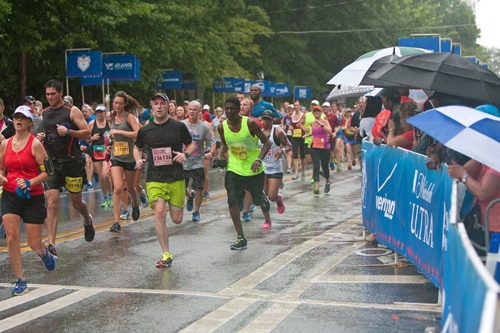
After rejoining the race, the three women who had run 12 miles building a solid lead over the chasers had become chasers themselves and ended up in 9th, 12th and 13th place: McClain timed in 1:11:27, Hurley in 1:11:38 and Kurgat in 1:11:50.
There was a lot at stake in this race. It was the selection event for the World Athletics Half Marathon Championships to take place in September, and there was $37,500 prize money on offer for the top three finishers out of a total purse (men and women) of more than $110,000. Levels of shoe company sponsor support would likely be riding on the order of finish and points in the World Athletics athlete database would be affected as well.
Just minutes before the leading women made that fatal turn, the leading men, escorted by motorcycles, had stayed on course by running straight through the same intersection. But by the time the women got there, their only guides were the vehicles they were already following (a police officer on a motorcycle, a car with a pace clock on top and a camera crew) motoring off in the wrong direction.
McClain, Hurle and Kurgat protested the official order of finish, but USA Track & Field (USATF) officials decided that the result should stand.
The top three official finishers--Born, Ellwood and Rodenfels, who were not aware of their 1-2-3 placements until after they finished--agreed that they had not earned positions on the World Championships team.
Once Born was appraised of the misdirection of McClain, Hurley and Kurgat, she declared on the spot that she would not go to Copenhagen. The final decision on who would go to the Worlds will not be made until May.
Should the women who went astray, who had seen a map of the race course, have known to go straight at the key intersection?
In principle yes, but the heat of battle has a way of clouding your thinking. If you're at your limit and have already been following three vehicles who all turned at the same time, you wouldn't question whether the three drivers knew where to go. There was no one at the road crossing to tell them any differently.

What happened to create what some were calling a "debacle?" Stories in newspapers and on radio and TV and social media commentary, tinged with outrage, led the public to conclude the three women were robbed, and the race organization — the Atlanta Track Club (ATC) — was to blame.
In general, the running community was more perplexed than outraged. The Atlanta Track Club is one of the most respected organizations in the sport. They organized the 2020 Men’s and Women’s Olympic Trials Marathon along with the massive Peachtree 10K which has served as the national 10K Championships numerous times. How could they allow this to happen?
Answers came from the race organization in a 1,000-word statement on Tuesday, and the level of detail that unwound a complicated story turned down the heat.
That the Atlanta Track Club would pay the three women first-through-third prize money matching their positions at the moment they went off course also quieted critics.
To summarize: the window of time during which the women passed through the intersection without official guidance was made narrow by an uncanny coincidence.
It began with a report of a police officer down after being struck by a car about a block away from the intersection, just as the lead women were approaching. The officer assigned to the corner rushed away to assist the downed officer without setting up cones to block the left turn. He was replaced by another officer who was not originally assigned to the race and didn't know where the course went.
Emergency vehicles were passing through the intersection, and in the confusion the driver of the women's lead vehicle, thinking the race had been rerouted, followed yet another motorcycle the wrong way.
(The officer struck by the car whose accident triggered the mix-up was taken to the hospital with a concussion and released the same day.)
Less than half a minute after the leading female went off course, the race-assigned officer returned to their post and in another minute other race-assigned officers arrived and placed cones to prevent the next runners from going off course.
For the full 1,000-word statement by the Atlanta Track Club, click here. For another account, see a piece by Jonathan Gault in LetsRun by clicking here.
The Atlanta Track Club has succeeded in shifting the narrative on the women's race from "they wuz robbed" to "things went wrong, but there's a good explanation."
The success depended not just upon the quality and thoroughness of the response, but also upon the speed with which it was delivered--just two days after the event, to prevent the erroneous story from continuing to fester in the minds of critics and crawl further through the labyrinths of social media. In addition, acceptance of responsibility was essential to maintaining the reputation of the event going forward.
To read an account of the race written in the immediate aftermath of the race and before the ATC issued their review on Tuesday, click here.
Mark Heinicke is Editor of Road Race Management E-News
About the Author